



This is true for everyone, where the perception that we understand life in a way nobody else does is an inherent facet of our psychology. That disconnect we feel is universal, and here's a piece of information that some people spread that might make you uncomfortable: The human mind evolved to grasp what is most advantageous to it, not to be the best at comprehending the truth.
Then, using this widely disseminated information, they deliver the fatal blow: What is useful is not always true. From this, it is evident that our beliefs are not as objective as they should be and that cognitive biases heavily influence our perceptions and reasoning.
Let's imagine you are looking at an image on a computer screen of a big party somewhere. Imagine now that you tell the computer to convince you that everyone with blonde hair is evil. To that end, the computer’s algorithm gradually edits the image to make it look as though each blonde-haired person has a smug, condescending, highly-punchable look on their face.
Now imagine that you tell the computer to make you feel wealthy, so it adjusts with one click the clothes, jewelry, and hairstyles of everyone in the picture to look worn out. Now imagine that you tell the computer to make this party disgusting, and it says to you, "Your wish is my command." You look around and see that everyone is sedentary, staring at their watches all the time, and the party has turned gloomy and boring.
This "computer" is none other than your subconscious mind, which modifies your perception of things in largely predictable ways, much like the computer does. Our experiences are nothing more than a reflection of our moods, whereby we interpret events to serve our self-interest and pay attention to things based on our identities' characteristics.
Therefore, when we consider whether people can only perceive what we perceive as true, we really mean that people can't see exactly what we perceive. For example, two people may look at the same party scene, but their "internal graphic design software" will distort it in completely different ways.
Psychologists call our minds' "graphic design software" (cognitive biases), which all humans share. Below is a list of some of the most well-known cognitive biases and how they affect our perceptions and thought processes. It's critical to recognize these biases to develop empathy, comprehend other people's perspectives, and end up deluding ourselves with them.
Although this list of biases is just the tip of the iceberg, it includes the most common and important ones, and we often fall into them.
Confirmation Bias
Definition: It is searching for "facts" that support our pre-existing beliefs while disregarding any data to the contrary.
This can be selective. Although selecting facts to support an individual's views is usually done willingly, confirmation bias actually occurs subconsciously. For example, you will notice the color yellow more frequently if you think it is your lucky color. This doesn't mean you are wrong, as there are many yellow things in your life, some of which are involved in your positive experiences.
Therefore, the issue with confirmation bias is not that you are incorrect but that you are blind to the broader perspective.
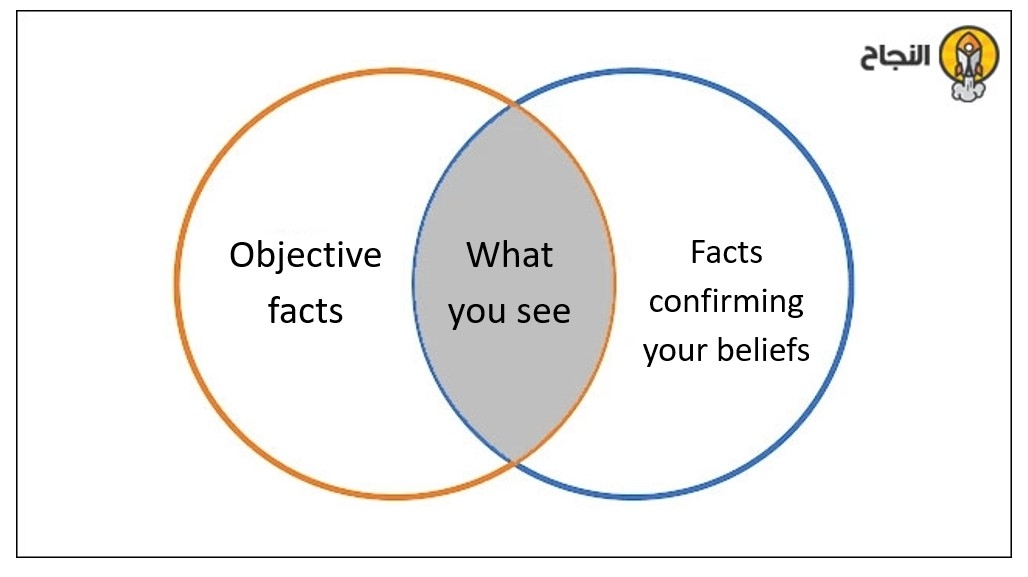
The strange and amazing truth about confirmation bias is that it spreads with increased information availability. This may initially sound counterintuitive because more information ought to strengthen our beliefs and lend them more authority, right?
However, the opposite happens with confirmation bias; the more information available, the more likely we are to choose "facts" to support our beliefs. So, acquiring more "selected" information reinforces them.
This explains why the Internet is a dirty breeding ground for political discourse. Instead of changing our beliefs to adapt to new information, we match and select new information to fit our preexisting beliefs.
In fact, the easy availability of confirmation bias online has created what researchers call “echo chambers,” where people continually only get fed information that supports their pre-existing views. This is good for the big tech companies because it keeps their customers in the dark, even when the information they hear is untrue.
How Does Confirmation Bias Make You a Fool?
Confirmation bias makes you feel more confident about your beliefs overall, making it difficult to discuss any topic with you, no matter how commonplace. Also, it causes you to believe that the evidence backs up your claims, ignoring any evidence that contradicts them.
Similarly, the person you are conversing with in real life or on social media platforms will have the same mentality, noticing all the evidence that supports their position while completely ignoring the evidence that supports your position. Although you will both look at the same picture, you will each interpret it differently. However, there are simpler ways in which confirmation bias equally misleads our lives.
For example, confirmation bias can impact the type of people we build relationships with. If you have preconceived notions about people—for instance, that all men are opportunists—you'll probably only run into instances of that stereotype in real life. This is because you will only notice the behavior you have labeled for people. So, you will only notice opportunism in men, ignoring all the caring and compassionate people you could meet.
Furthermore, you will never experience happiness in life, and even the greatest happiness in the world won't be enough to fill your glass if you approach life with a pessimistic outlook and only see its empty half.
Mothers who constantly criticize their children's actions and assert that they know what is right when, in reality, they are frequently in error are the best examples of confirmation bias.
Negativity Bias
Definition: Negativity bias is the tendency to ignore the positive aspects of things in favor of focusing on their negative aspects. It can be categorized under pessimism, but it goes beyond simply anticipating a negative outcome; it involves recognizing negative aspects and elevating them above positive ones.
From an evolutionary perspective, it's an adaptive strategy. The caveman who survived is the one who saw the possibility of an issue or crisis. However, the caveman who allowed himself to savor tasty fruit and was constantly appreciative of the lovely environment around him was the one who was devoured by predators.
Negativity bias appears in several forms. We perceive the loss of something as more painful than the joy of gaining it. For example, we may take negative feedback more seriously than positive, pursue and believe more gloomy predictions than positive ones, form negative impressions, believe that negative stereotypes are more common than positive ones, judge someone's character more heavily based on their negative behaviors than many of their positive ones, and so on.

A diagram describing “loss aversion,” or the tendency to bias avoiding loss over achieving gains.
Psychologists have found in every domain they've researched that our minds naturally give extra weight to negative experiences.
How Does Negativity Bias Make You a Fool?
The danger with the negativity bias is that we lose perspective on what’s actually a problem and what’s just us losing perspective. Examples of this include the arrogant person who lives a luxurious life and explodes in anger when his waiter mistakes his order or the girl who constantly complains about the lack of Wi-Fi on the plane, oblivious to the significance of air travel as a revolutionary advance in transportation.
These are not just little annoyances in life; negativity bias seeps into some of the most personal aspects of our lives, as demonstrated by the times you meet someone wonderful but decide to avoid them because you think they are careless because of their dirty shoes or the times you fail to recognize the wonderful qualities your partner brings to the relationship because you are fixated on changing something that bothers you.
Negativity bias can extend to the professional field and communities as well. In management, it's a well-known saying that no matter how hard you try to appease your staff, they will still complain even if circumstances improve.
Despite the numerous pieces of evidence demonstrating the remarkable progress in all fields, we observe that a culture of complaint is pervasive worldwide. We may forget this, but consider how the world has changed in recent years from one dominated by slavery, extreme poverty, devastating wars across continents, and millions of victims to what it is today. We may not realize how far society has come in terms of luxury and prosperity, but if you spend a few hours on social media, you would think the end of the world is near.
Your ungrateful teenage daughter is the best example of negativity bias. Despite that you give her everything she needs—clothes, food, shelter, education, and money for a variety of interests and activities—she still claims that you "ruined her life" because you weren't totally fashionable in front of her friends.
Incentive-Caused Bias
Definition: The incentive-caused bias is the significant human response to rewards and punishments. It is characterized by our high enthusiasm upon receiving a reward for an accomplishment and our avoidance of what causes us danger, threatening and possibly punishing those who do not grant us better privileges. “It is difficult to get a man to understand something when his salary depends upon his not understanding it,” as writer Upton Sinclair once said.
The incentive-caused bias drives us to make irrational, unwise, or unethical decisions driven by our own incentives.
We continue to spin in a never-ending circle of causality, feeling good about things that work in our favor and bad about those that do not. Similarly, we tend to justify reasons to enhance good feelings and fabricate reasons to avoid anything that gives us bad feelings. Our minds will work to persuade us that this benefits us if we choose our incentives based on the benefits we will receive from them. As a result, people frequently disregard higher moral or social standards to gain immediate benefit from dishonorable actions.
It is easy to sit and say, "What a bunch of bad people. I can't act like them!" However, in practice, we may not hesitate to do those actions; it's just that we can't see how we do it, or our minds block us from seeing it.

How Does the Incentive-Caused Bias Make You a Fool?
The incentive-caused bias highlights the ugly aspects of our behavior in specific situations rather than making us bad people. For example, an executive may be enticed to take short-term risks at the expense of the company's long-term safety by appropriate stock prices and a "golden parachute," potentially increasing his own profits in the short term but endangering the company as a whole over time.
Also, consider the poor American prison system and even detention centers that are equipped to keep more people in prison for longer periods without encouraging rehabilitation or education that could prevent prisoners from committing crimes in the future.
When we indulge in incentive-caused bias, we turn into bad people and perhaps monsters. However, on the bright side, we can design smarter systems that remove bad incentives and enhance good ones. As we see through the incentive-caused bias, humans respond to intimidation and enticement policies, and all we have to do is think carefully about when and how to use them.
The person who acquires enormous sums of money through dishonest means and occasionally purchases real estate is the best example of this bias, yet is always preaching about people's lack of success due to their laziness.
Actor-Observer Bias
Definition: The actor-observer bias is the tendency to attribute our own negative behavior to external causes beyond our control while attributing others' negative behavior to internal causes within their control. If you fail at something, you try to find an excuse to absolve yourself of responsibility. However, if someone else makes the same mistake and fails, you will likely blame them and call them bad.
Similarly, when you drive a car and commit a traffic violation, you justify your violation with compelling reasons. In contrast, you blame others if they commit the same violation, calling them the worst names.
How Does the Actor-Observer Bias Make You a Fool?
You may not realize it, but the actor-observer bias turns you into a very unpleasant, bad person. This bias can appear in many different ways. For example, it can occur when you argue with your partner, defend your poor actions, and chastise them for theirs.
You might justify cheating a little bit on an exam at school because you had so many other responsibilities that you couldn’t study. Still, when another student's cheating is discovered, you judge them immediately. Also, you may arrive late and blame the traffic, while when your friends are late to meet you, you take it as a personal affront to your dignity as a human.
Your rude older brother, who used to hit you whenever you bothered him or messed with his belongings, is the best example of the actor-observer bias. You exact terrible revenge on him, becoming the rebellious child and the bad apple in your parents' eyes.
Group Attribution Bias
Definition: Bias is the prejudice that makes us believe that an individual's traits are the same as those of the group or groups to which they belong. Stereotypes based on race or gender are the clearest examples of this bias.
It is important to note that your mind consumes a lot of energy, and there is a lot of sensory data and information that needs to be scrutinized. For these reasons, the brain uses all of these cognitive biases as time—and energy-saving shortcuts.
How Does Group Attribution Bias Make You a Fool?
Group attribution bias makes us easily become racists or sexists, which is obviously bad behavior. However, the odd thing about group attribution bias is not that we fall victim to it, because we all do it sometimes, and even if you don't think you do, there's probably a bias (or reason) for that.
Since group attribution bias is a natural human tendency, how we attempt to take advantage of it for our own gain is particularly fascinating. We do not consider people to be members of perceived groups even when they are not anything like those groups, but we seek to identify with groups that enhance our self-worth and morale socially.
Put another way. We actively attempt to manipulate other people’s group attribution bias in our favor. We buy clothes and cars and pretend to be extravagant to show the world that we’re classy, very cool, or modern. We will hang around groups we want others to associate with, thinking it will give us prestige. We use slang idioms and expressions that match our preferred group of choice in hopes that others will identify us as part of that social group.
Spending time with people elevating your social standing is not bad. However, when you take advantage of them to advance in society, you become an opportunistic and exploitative individual. Similarly, it is acceptable to point out that certain individuals belong to a larger group or category. However, if you treat these individuals with the same blind prejudice that you apply to the group as a whole, you may have a problem. Put plainly, regard every person as an end in and of themselves rather than as a tool to achieve an aim.
Your racist grandfather making disparaging remarks about a group, followed by everyone lowering their heads and acting as if they did not hear him, is the best example of this kind of bias.
Can We Overcome Our Cognitive Biases?
Our cognitive biases should no longer be an issue since we are now aware of them, right?
Merely being aware of these cognitive biases is insufficient because they are an ingrained characteristic of human nature that cannot be changed. We must remain cognizant of them at all times, particularly during critical times when we fall victim to them. Therefore, perhaps the best tool for managing your biases is your ability to be more conscious and vigilant in your life.
We know mindfulness has become a general buzzword that is supposed to cure society of all ills and more. However, what we really mean by it is cultivating a consistent level of self-awareness in which you can recognize, analyze, and critically examine your thoughts and beliefs regularly.
The first step to overcoming your biases is acknowledging them, but developing self-awareness does not guarantee that you will see your biases when they arise. It entails delving deeper to discover why you seem to lose control over your thoughts and emotions in the face of those biases.
Here are some examples:
- Why are you pessimistic and only see the bad in everything? Maybe you have some unresolved resentment you need to work through.
- Why do you indulge in the arrogance of thinking you are always correct? Maybe you're trying to hide some deeper-seated insecurities about your intelligence.
- Does the bias in group attribution serve a pressing need for success? Is the desire to feel as though you belong to some group so strong that you’re willing to demonize some other group to feel it?
The best we can do is learn to control and subdue our cognitive biases since they are an essential component of our perception. They will eventually take over and entirely dominate us if we don't.




Add comment