



However, the opposite may be true in many cases; some people have more motivation than they should.
For example, according to the classical perspective, most people struggle with learning because they lack the motivation necessary to do so. Learning is challenging, but playing on your phone or watching TV is not, so in order to avoid these distractions, one needs to be highly motivated to learn.
In fact, it turned out that otherwise was much more common. People with high levels of motivation may want to work on multiple projects at once, making it difficult for them to concentrate on just one until it is finished.
Over-Motivation Leads to Apathy in Execution
There are two common characteristics that prevent a person from achieving the accomplishments they desire, and they are:
- A very big motivation that magnifies ideas, scenarios, and goals.
- Little motivation to implement the things these ideas require.
Giving someone with these characteristics a motivational speech or an inspirational book may not be a good idea because it will only make them think more than they already do about what they should be doing.
Motivation is frequently advantageous, especially for those who lead sedentary lives. Motivation is more effective when a person lacks ideas and dreams than when they have a surplus of them, as this is when improvements in behavior are more likely to occur if someone is stuck in a pattern of monotonous behavior.

Signs of Over-Motivation
These people tend to indulge themselves in imagining new projects and travel destinations and are always looking for self-improvement. These ideas are great, but overdoing them frequently can be disastrous because the person will switch their attention from one project to another without committing to one, and it can take a long time to establish a clear structure for life that lessens this destructive trait.
Consider the life objectives you haven't succeeded in achieving to determine whether you have too much or too little motivation. These could be objectives that, at least once in your life, you considered to be of the utmost importance but fell short of due to something that could have been prevented, like giving up.
If you stopped putting forth the effort to accomplish these goals, consider whether it was because you simply lost interest in them or whether it was because you started focusing on and giving priority to another goal.
Low motivation is demonstrated by losing interest in your current goals and not working hard enough to achieve them so that they become habits. Which means that, for some reason, you were unable to maintain the necessary motivation to complete the project.
On the other hand, when a new goal replaces the old project and the old project loses its priority in your life while you are busy with the new project, you often suffer from over-motivation, as your failure to suppress the new idea has led to your failure.
This tendency to replace an old goal with a more important one may be wise if it only happens once in a while. Your sense of priority is a way to get the most out of your limited effort and time. But if it becomes a pattern in your life and devalues your goals because they are replaced so quickly, the pattern can become destructive.
Motivation Curves
Because there are constantly conflicting impulses going through your brain, motivation is not a constant psychological state. The typical motivation curve might resemble the following:
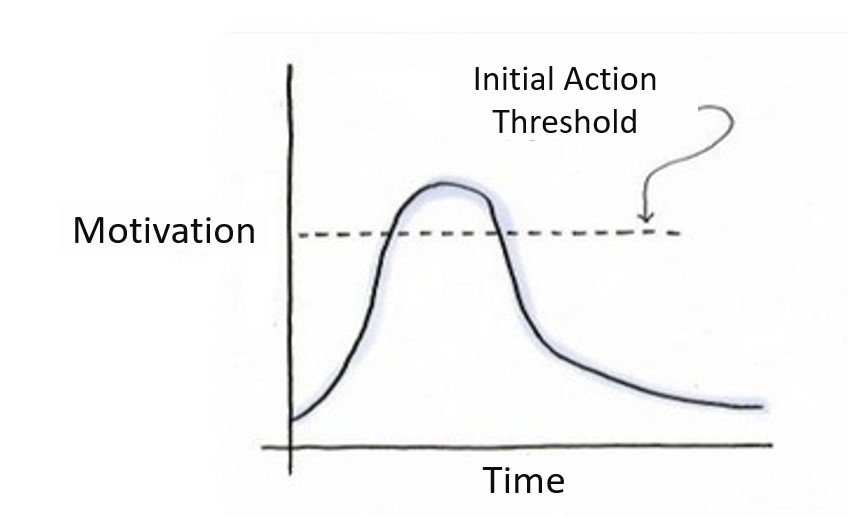
The particular motive intensifies until it reaches a threshold at which you begin to take initial action to achieve your goal, and the motivation persists as the action continues. But as with all emotional states, motivation will eventually return to normal levels.
If you're lucky, you might be able to create your project and goal with a continuing-to-work threshold that is lower than your immediate emotions. If not, you'll probably lose motivation and abandon the project.
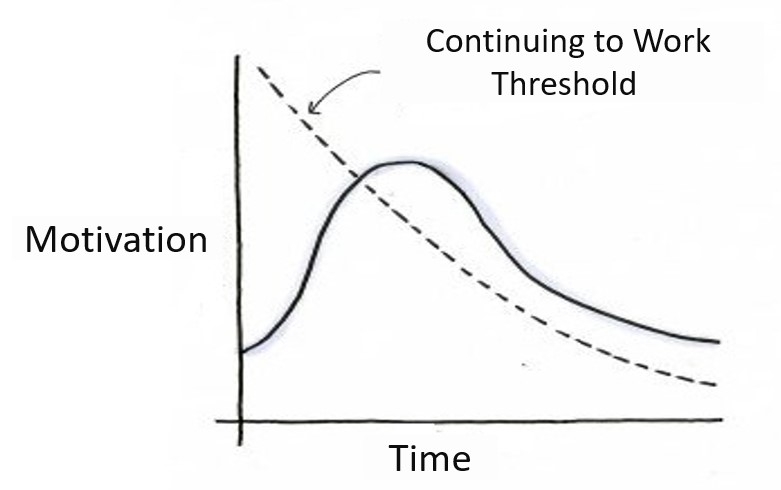
You may be able to increase your motivation intermittently, and this is especially necessary for long-term goals, but it remains a less important factor than lowering the threshold for continuing to work because increasing motivation is not fixed.
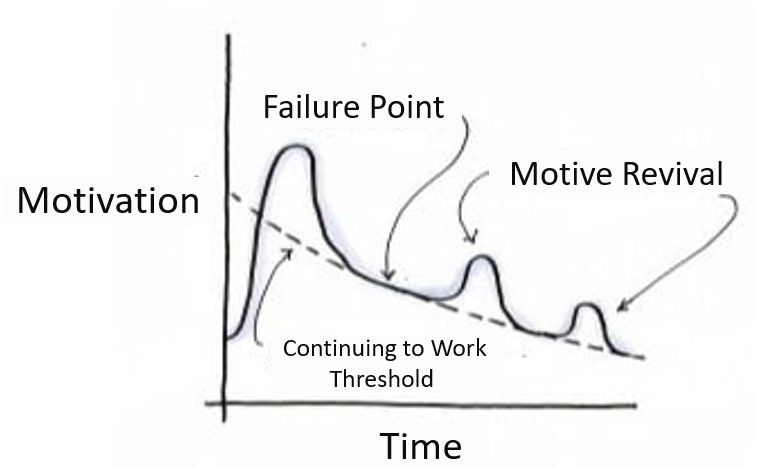
Habits, goal setting, and project design are ideas that largely aim to capitalize on the flood of motivation you have at the start of the project. So you should use this extra motivation to strategically design systems so that the actions needed in the long run are kept below the threshold for continuing to work.
Note: The initial action threshold starts at a much higher level than the threshold of continuing to work because these actions are still new and have not yet become ingrained habits. On the contrary, it becomes easier and easier to continue working with the passage of time, so the line slopes downward because more actions turn into habits and behaviors that you perform automatically in pursuit of your goal.
Why Does Over-Motivation Complicate Things?
The previous curves depicted the motivation for a single project or goal; however, when you consider that you might be motivated by multiple projects or goals, the situation changes dramatically. When that occurs, things will get very tricky because your primary objective will no longer be your top priority—not because pursuing it was exhausting for you, but because new interests have taken its place.
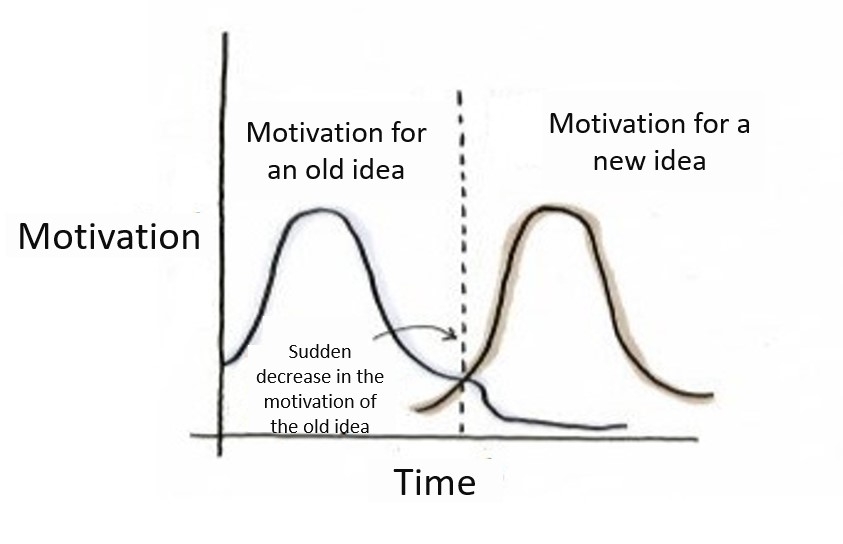
The curves remain the same in this case, but now you have multiple motivations competing to occupy your limited time, effort, and enthusiasm.
This frequently results in a never-ending cycle of old ideas being replaced by new ones. The new idea carries a strong motivation, which leads you to ignore the stage of doing the act because it does not carry this same motivation. In order to achieve success, you must calm this motivation instead of pursuing it.
How Do You Reduce Over-Motivation?
The best strategy is to follow the one-project approach, so decide to work on only one major project and make it your highest priority. As for the other projects, they are secondary and cannot replace the first one until you finish implementing it.
In practice, things might be trickier. You might only be working on one project at a time in each field of your life, such as work goals and hobby-related goals, which don't typically conflict with one another. It can be challenging for you to distinguish between what is legitimate and, therefore, subject to this rule and what is typically one of many things you would typically anticipate doing in a day or a week.
Planning as if you only have one major project will help you avoid getting sucked into new ideas while you are still working on the old project and will ensure that this strategy is still effective despite all of the complications.
Planning projects without starting them is a helpful strategy for overcoming over-motivation, the objective is to maintain focus despite all of your options. But it might make more sense to simply plan how to implement the new project after your current project is finished, rather than devoting a significant portion of your time and energy to the detriment of your current project.
Write down points, set timelines, and figure out what your project needs to do. These simple, realistic actions are usually enough to keep you from losing focus.
Setting goals that are less ambitious but shorter-term is a final strategy that is uncommonly used but has great potential. Try to choose projects that you can finish in a month rather than ones that will take years to complete if you are aware that you get overly motivated by new projects.
Small projects may be less ambitious, but at least you can keep yourself motivated for a month or two, and some other projects may require more time, but perhaps not continuous time. For example, you can work out as hard as you can for one month, then try something else while just trying to keep the old habit, and later, when the motivation to exercise wears off, you can work again on that project and try to reach higher levels.
The main difference between the small project approach and what over-motivated people do is that you really intend to complete these projects and are planning accordingly. While knowing that your project will only take one month forces you to reconsider how to design it as it ensures that it will become just another habit, allowing projects to succeed or fail based on your mood may prevent these projects from achieving sufficient stability to turn into an automatic habit.
In Conclusion
Over-motivation can be both a blessing and a curse because it indicates that you have the motivation and ability to accomplish your goals, but it also requires a lot of self-control because you must control some of your impulses in order to make positive changes in your life. If you can do that, you won't be chasing the high energy that comes with new ideas but instead will be more dedicated to working hard, and in the long run, your life will be happier.




Add comment