



Note: This article is based on the work of author Vanessa Van Edwards, in which she tells us about 8 ways to deal with the difficulty of making decisions.
During shopping trips, people often get overwhelmed when choosing products, food items, or household necessities.
Decision-Making Paralysis
It’s a psychological phenomenon where one hesitates and struggles to choose among multiple available options, finding it incredibly challenging to reach a conclusion.
This phenomenon can manifest in various aspects of life, from simple everyday choices like choosing a meal to life-changing life decisions like choosing a career.
This abundance of options can trigger stress, anxiety, postponing, or avoiding decision-making altogether.
The brain tries to identify the best possible choice, whether it’s something as mundane as picking an ice cream flavour or something more involved, like deciding on a career path.

The Consequences of Having Too Many Choices
People make poor decisions when overwhelmed by too many options. American psychologist Barry Schwartz explains in his book, The Paradox of Choice, that limiting the number of available choices can significantly improve decision-making because:
- The more options there are, the less effective decision-making becomes.
- Too many options lead to indecision and cause indecision.
- People spend more time dwelling on the choices they didn’t make rather than feeling satisfied and optimistic about the decisions they did make.
Tips to Handle Decision-Making Challenges
Here are eight tips and tricks to navigate such challenges:
1. Seek a Friend’s Help
You can ask a friend to decide for you and then observe how they make you feel about their response. If you feel uneasy, you might want to disregard their suggestion, but if you feel hopeful and excited, it’s a sign to go with it.
2. Use the “5-3-1” Decision Funnel
The "5-3-1" Decision Funnel is a process that goes through the following steps to filter through your options and make a decision:
2.1. Shortlist 5 Options
First, you must narrow your list to 5 options fitting the situation.
2.2. Reduce to 3 Choices
Assess these five options based on your priorities, values, and the relevant criteria. This step requires reducing the options to 3, which helps minimise indecision and hesitation caused by an overload of choices.
2.3. Make the Final Decision
You can either follow your intuition or weigh the pros and cons of the remaining options to make your final decision. This approach simplifies the decision-making process and eases the associated stress and confusion. It guarantees that you weigh your choices in an organised manner devoid of contradiction and indecision.
3. Use the "A Work" Method
It groups tasks according to your degree of skill and enjoyment to increase productivity. This approach helps you manage tasks by sorting them into the following categories:
3.1. "A Work" Category
This includes tasks that you excel at and thoroughly enjoy doing. You can complete them effortlessly, becoming fully immersed in them, and after you're done, you get a great sense of satisfaction and accomplishment. Time flies when you work on such tasks, as they demand your full attention and energy.
3.2. "B Work" Category
This category includes tasks that you are proficient at but don't truly enjoy. You can complete them efficiently, yet they lack the fervour that comes with the "A Work" tasks.
3.3. "C Work" Category
This category covers tasks you can do but tend to procrastinate on or avoid. These tasks don’t excite you; you perform them without enthusiasm or energy.
3.4. "D Work" Category
These tasks are more challenging, require more time and effort, and are usually completed less effectively. Completing these tasks brings minimal fulfilment.
3.5. "F Work" Category
You should avoid tasks in this category as they drain your energy and are often riddled with mistakes. These tasks generally erode productivity and morale. Effective decision-making isn't just about managing time or tasks; it also requires sorting tasks by their efficiency level and your personal preferences. Focus on "A Work" tasks while delegating others to your team to ensure the best use of talents and skills, increasing overall productivity and satisfaction.

4. Narrow Down to 3 Options
I used to present 20 options for projects to trainees at the company, including opportunities in fields like editing and public speaking. However, the trainees took a very long time to weigh the pros and cons of each option, which corresponded with many emails. This led many to withdraw from the projects soon after they started, and a few even contacted me weeks later to apologise for their prior decisions and request a change of tasks.
In the end, I decided to reduce the number of options to just 3, which improved the trainees' commitment and dramatically accelerated decision-making. This is because decision-making becomes easier when options are limited, prompting us to make the most of the available choices. The takeaway is that it's best to limit the choices to three when leading projects, hosting events, or any other activity that requires decision-making.
5. Use the "Two-Minute Rule"
This is a clear-cut method for easy, non-critical decisions. It involves making a final decision immediately, without delay, if the process takes no more than two minutes. This is particularly useful for routine decisions that don't need to be well thought through and won't have a big effect on your long-term quality of life. Here are some examples:
- Responding to Non-Urgent Emails: You should reply to non-urgent emails within two minutes.
- Choosing a Coffee Flavour: Decide on your coffee flavour if the choice can be made in two minutes or less.
- Selecting a Music Playlist: Quickly pick a playlist and enjoy the music.
- Choosing a Lunch Spot: Decide where to have lunch within two minutes.
- Choosing Your Outfit: Stick to a predefined style to save yourself the hassle of making outfit decisions every morning.
These quick decisions help clear your mind, boost your decision-making confidence, strengthen your intuition over time, and reduce the mental clutter that can sometimes lead to poor decisions.
Note: When you hesitate or feel anxious about making a decision, you can apply an even faster method, such as the Three-Second Rule.
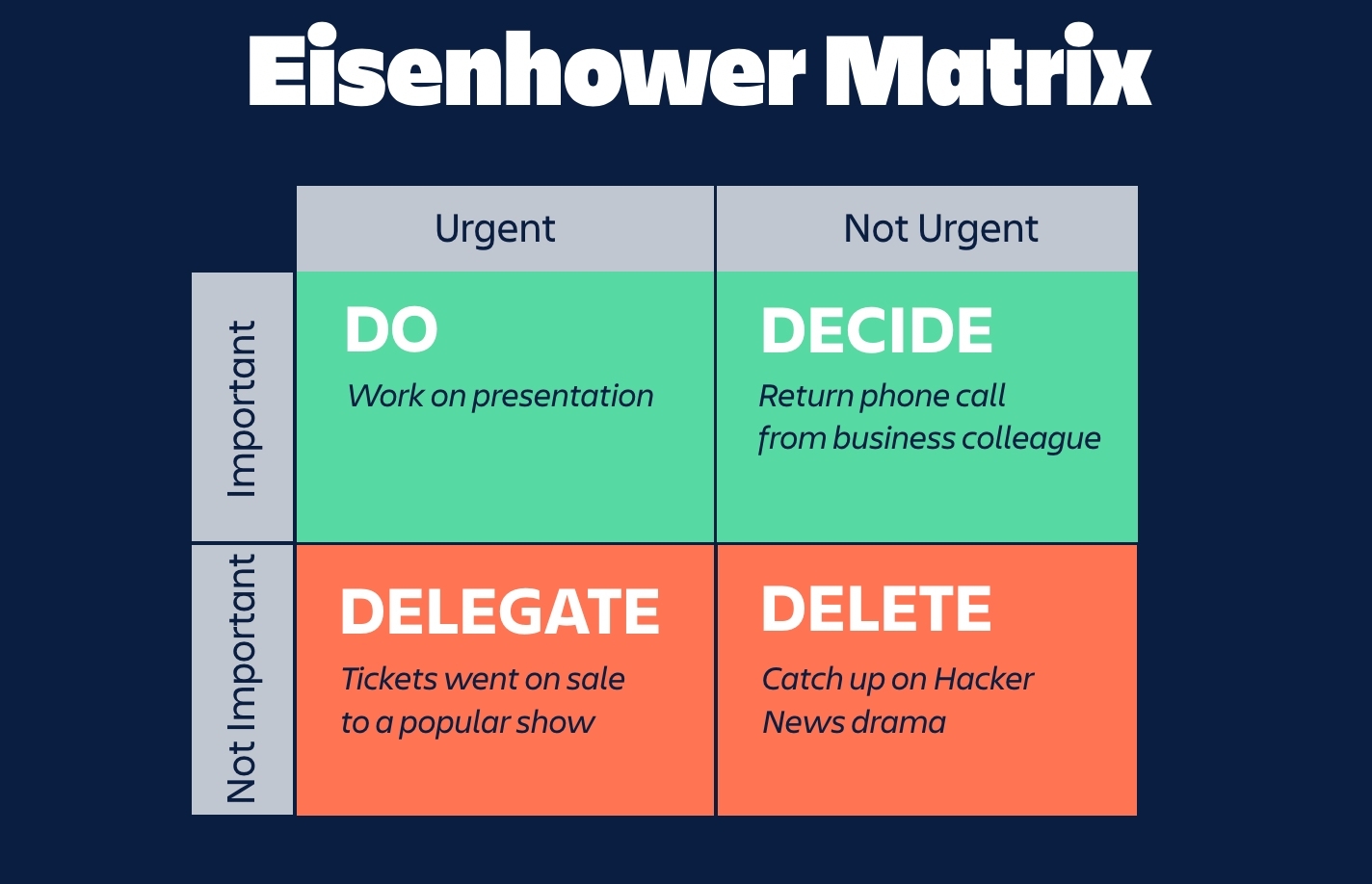
6. Use the "Eisenhower Matrix"
It is a tool to help you overcome decision-making paralysis by categorising tasks based on their urgency and importance.
The Eisenhower Matrix consists of four quadrants:
- Top left quadrant: Urgent and important (Do the task immediately).
- Top right quadrant: Important but not urgent (Schedule the task for later).
- Bottom left quadrant: Urgent but not important (Delegate the task).
- Bottom right quadrant: Neither urgent nor important (Eliminate the task).
Assigning tasks or making decisions within the Eisenhower Matrix:
- Complete urgent and important tasks immediately.
- Schedule important but non-urgent tasks for a later time.
- Delegate urgent but less important tasks.
- Eliminate tasks that are neither important nor urgent.
This method not only improves decision-making efficiency but also adds a touch of humour as you realise just how many tasks can be deleted or delegated.
7. Use the "Uniform Approach"
This technique is intended to increase the effectiveness of decision-making, especially when dressing in the morning. Many global celebrities, including American entrepreneur Steve Jobs, for their everyday wardrobe choices. Here's how to put it into practice:
7.1. Choose Your Signature Style
Select a few key clothing items that make you feel comfortable and confident. These might include specific types of shirts, trousers, or dresses you can wear regularly.
7.2. Create Outfit Combinations
Pair certain clothing items together to create a set of outfits. American entrepreneur Mark Zuckerberg adopts this strategy, as evidenced by his black or blue suits and grey shirts. It reduces the number of daily decisions.
7.3. Add Accessories
Accessorise your appearance with scarves, ties, or jewellery to switch things up without having to make additional decisions.
7.4. Establish a Morning Routine
Pre-determine your breakfast options or set a consistent schedule for exercise, for example.
7.5. Additional Examples
- Set breakfast menu: Stick to specific breakfast options throughout the week.
- Use the same coffee mug each morning.
- Fixed exercise routine: You could practice yoga during the week and go for walks on weekends. Reducing these routine decisions helps conserve mental energy for more important ones.
8. End-of-Day Reflection Session
Every night, have a quick strategic thought session to get ready for the next day and overcome decision-making paralysis. This involves dedicating a certain amount of time each night to make a thorough and well-thought-out plan for the tasks, actions, and decisions you’ll face the following day. This approach helps reduce stress and increase focus in the morning.
Process Details:
- Time required: 10 minutes every evening.
- Reflection: Note which decisions and actions went well and which didn’t during the day.
- Prioritise: Pick three main tasks for the following day.
- Make preliminary decisions: Make some routine, simple decisions for the next day in advance.
Applying It across Different Areas:
- Professional: Identify the first work task for the next day.
- Personal: Choose a workout or relaxation activity.
- Well-being: Choose a simple self-care activity for the evening.
You can reshape your morning routine by having a reflection and planning session each evening. This helps you strategically plan your daily life and boost productivity.

The Impact of Decision-Making Paralysis on Retirement Plans and Medical Procedures
Decision-making paralysis is a serious, widespread issue explored in several research studies, including the following:
One study carried out at Columbia University examined the retirement savings choices made by Vanguard's clientele. The findings revealed that participation in retirement savings plans decreased as the number of options offered increased. When the options were reduced to five, more than 70% of participants signed up for the plans. However, when there were 35 options, the participation percentage fell to 63%. The increased options caused decision-making paralysis, leading to a potential economic crisis due to delayed retirement savings.
Another study examined doctors' treatment options for patients with degenerative joint disease. The results mirrored those of the previous study. At first, just one more course of treatment was suggested, and most medical professionals favoured it over surgery. When two more options were presented, more doctors opted for surgery. This implies that procrastination and the desire for automatic or definitive decisions result from having more options. These studies show that people often resort to reflexive choices when faced with complex dilemmas.
FAQs
1. Why Do I Struggle to Make Decisions?
Indecision is a typical response to a phenomenon psychologists call "decision paralysis" or "analysis paralysis." This happens when the brain is overwhelmed by many options and potential outcomes. This condition stems from our dread of making the incorrect choice, perfectionism's pressure, and the mental strain of weighing multiple options. Cognitive overload results in a decision that is impossible to make and temporarily paralyses the decision-making process.
2. What Causes Decision-Making Paralysis?
Several factors play a part in this, the most significant being the sheer number of options. The brain struggles to weigh and assess all the possible outcomes, leading to confusion, hesitation, and indecision. Other contributing factors include the fear of making the wrong choice, consequences, perfectionism, and sometimes unconfidence in one's reasoning abilities. This paralysis often worsens when the decision is crucial.
3. Does Overthinking Lead to Decision-Making Paralysis?
Overthinking involves analysing every possible option, result, consequence, and implication, which in turn causes decision-making paralysis. This excessive thinking keeps us from reaching a satisfying conclusion and forces us to keep weighing our options. Making decisions gets harder the more overthinking we do, which makes it harder to respond quickly when necessary.
4. How Can You Commit to Difficult Decisions?
Implementing difficult decisions requires three key elements: commitment, confidence, and effective coping strategies. The first step is to reaffirm the decision by reviewing its justifications and importance, boosting your confidence in it.
Next, you should develop contingency plans to navigate any consequences that may arise during implementation, including psychological and practical preparedness for potential challenges. The final step is to build resilience, understanding that no decision is completely risk-free, and get ready to deal with unexpected scenarios. Committing to a decision necessitates being fully prepared to handle any obstacles or issues that may arise while it is being carried out.




Add comment