



We see something far more personal — what that student has learned about themselves.
- Do they trust their own judgment?
- Do they fear mistakes or learn from them?
- Are they looking for meaning, or only for safety?
The exam, however technical and time-bound it appears, is in reality an educational and psychological mirror. It reflects the kind of relationship the school has built between the learner and their own thinking, between knowledge and life, between decision and responsibility. And this intense moment does not emerge from nowhere. It is the product of a long path of classroom practices, unspoken signals, and assessment patterns that have been shaping the student, day after day, into a particular way of thinking and acting (Biesta, 2013; Putwain, 2017).
This article does not treat the exam as an isolated assessment tool. It treats it as the final expression of a long educational journey, one that reshapes not just the level of knowledge, but the very shape of thought.
The Exam as a Moment of Revelation, Not Just Assessment
Educational debate has long been preoccupied with a question that seems straightforward enough: Are exams good or bad? But this question, widespread as it is, reduces the real problem and steers the conversation away from what actually matters. The issue is not the existence of the exam itself. It is its gradual transformation into a governing logic, one around which the school, the curriculum, the teaching, and even the relationship between teacher and student are reorganized.
When the exam becomes the implicit destination rather than the tool, the school begins, without fully realizing it, to train minds in a particular pattern of thinking and choosing. That pattern rewards compliance, speed, and surface precision, while sidelining patient thought, personal judgment, and the willingness to take responsibility. In this sense, the exam does not create the student's behavior so much as it exposes it.
In that intense moment, what rises to the surface is what has quietly taken root over years of silent learning: the reflex to reach for the expected answer; the fear of mistakes, as though they threaten one's standing; discipline experienced as a survival strategy rather than a conscious ethical choice. This is not simply about intelligence or effort.
It is about a pattern of adaptation the school cultivates, teaching students how to pass through the system with the fewest losses possible, inside a structure that rewards predictability and speed. Under pressure, the brain defaults to automatic responses rather than reflective ones (Kahneman, 2011). And from an educational perspective, what surfaces in exams is often the residue of a hidden curriculum, one that has silently communicated to students what is safe and what is a risk (Jackson, 1968).
What the Student Has Already Learned Before the Exam?
Before a student even enters the examination hall, they have already learned many things that never appear in the textbook. They have learned how to read the teacher’s facial expression in search of the “correct signal.” They have learned to detect from the tone of feedback whether a mistake is tolerated or humiliating, and to judge when to speak and when to stay quiet. These may begin as survival skills in the classroom, yet over time, they can become habits of thought that restrict initiative.
The pattern shows up in familiar situations. A high-achieving student may glide through past exams, yet hesitate the moment they are asked to explain why they chose an answer or defend an idea. The hesitation is not about understanding. It comes from an earlier lesson, absorbed quietly: that thinking out loud risks exposure, while selecting quickly is safe. On the other hand, a student who comes alive in open discussions or class projects may suddenly freeze during a formal exam because the message they have internalized over the years is clear: there is no room here for trying.
This plays out repeatedly in humanities classes, which are theoretically meant to be spaces for thinking and interpretation. When a student holds an unconventional reading of a text or a critical perspective on a historical event, they often suppress it entirely, scanning instead for the answer that will satisfy the teacher or the marking rubric. In that moment, they are no longer analyzing the text or grappling with the event. They are predicting what is required of them.
And so, the student learns that success means imitating the model answer, not building a genuine position. They become skilled at sitting exams, but far less equipped for the moments in life that call for real judgment and an independent stance.
This is precisely what Philip Jackson described in Life in Classrooms (1968): classroom life is shaped by unwritten rules just as much as by academic content. When those rules are reinforced year after year, they produce a conditional relationship with knowledge: I learn to avoid loss, not to build judgment or meaning.

Exams and Decision-Making Under Pressure
In an exam, the student is asked to "decide" quickly. But the decision here is a closed one: limited options, clear criteria, time pressing on the nerves. One strategy is rewarded above all others: recognize the pattern as fast as possible and apply it with minimal reflection.
This kind of decision-making relies on fast, automatic thinking. Daniel Kahneman describes this in Thinking, Fast and Slow (2011) as the brain’s instinctive mode, one that favors speed over deliberation. It may work well for closed, standardized questions, but it does not build what students will actually need beyond school: the ability to think slowly; to exercise rational judgment; to navigate uncertainty and tangled information; to read a situation in context; and to take responsibility for a choice when no ready-made answer exists.
A simple example makes this concrete. A true-or-false question trains the student to catch a keyword and respond instantly. Later, in professional life, the task looks entirely different; it means reading an entire situation, accounting for variables that aren't visible, and making a call without any model solution waiting at the bottom of the page. Even in personal relationships, decisions are rarely multiple-choice; they are positions whose consequences extend into other people's lives.
When we train students for the exam alone, we are training them in the form of decision-making, not in its substance.
The Exam as a Test of Identity and Responsibility
The exam does not only test knowledge, especially when the stakes are high. It exerts real pressure on identity. Three questions take shape quietly in the student's mind:
- Does my performance reflect my actual ability?
- Is my worth measured by this result?
- Does making a mistake mean something is wrong with me?
These are not exaggerations. They are a well-documented psychological experience for many students, particularly when personal value becomes tied to the grade alone (Putwain, 2017). And at that point, the exam becomes a moral test as well:
- Do I accept the consequences of my choice?
- Do I reach for shortcuts?
- Do I tell myself the end justifies the means?
When a student feels that their entire future has been compressed into two hours, integrity can start to feel like a luxury they simply cannot afford, not because they lack values, but because the environment has quietly pushed ethical reflection aside. In contexts like these, building integrity is a matter of educational design, not of moral speeches. Research on deeper learning shows that developing responsibility and a genuine learning identity requires experiences that engage students in meaning and genuine choice, not just in compliance (Darling-Hammond et al., 2020).
From Training in Compliance to the Erosion of Personal Judgment
When school life revolves around the exam, students learn to hold their minds in a posture of anticipation rather than judgment. They learn to ask, "What does the examiner want?" What will be on the test? What strategy will get me the highest score? These are reasonable questions in an assessment context. They become dangerous when they solidify into a permanent orientation toward life.
A profound ethical shift happens here: self-accountability weakens, and the tendency to go along quietly strengthens. Paulo Freire warned of this in Pedagogy of the Oppressed (1970): a system that treats learners as containers to be filled weakens not only knowledge but also agency and responsibility. Gert Biesta (2013) extends this: when education is reduced to what can be measured, dimensions of equal importance fade from view, such as maturity, selfhood, and the capacity to exist as a responsible person.
A recurring scenario captures this clearly: A student earns consistently high marks yet hesitates the moment they are asked for an opinion that is not governed by a clear framework. It is not that the thinking is missing. It is felt that safety is missing when genuine choice is on the table. Ask that same student to suggest solutions to a real problem in the school or the community, and something telling often happens: they reach for familiar narratives rather than new ideas, not because they lack alternatives, but because experience has taught them that stepping outside what is expected carries a cost, and that safety lies in alignment, not in testing their own thinking.
Why Exam Culture Runs So Deep in Lebanon and the Arab Region?
In Lebanon and across much of the Arab region, the exam has long outgrown its pedagogical function. It has become a dense social and economic symbol that governs life trajectories and determines individual futures. In societies marked by fragility, grades and certificates are often perceived as one of the very few reliable paths upward. The official exam can feel like a dividing line between a possible future and a foreclosed one. When opportunity is scarce, the stakes rise, and the pressure on students, families, and schools intensifies accordingly.
Reports from the World Bank and UNESCO indicate that traditional assessment systems in the region function not only as tools for measuring knowledge, but as sorting mechanisms closely tied to the scarcity of social and economic opportunity. This quiet link between certification and future possibility amplifies anxiety and transforms the school from a space of learning into a high-stakes competitive arena, one in which a student's worth seems to shrink to the size of a single grade.
In fragile contexts, this model quietly deepens inequality: high-stakes assessment tends to reward students who already have access to supplementary resources, such as private tutoring, stable home environments, and consistent conditions for study (World Bank, 2020). UNESCO is clear that educational recovery cannot come from improving results alone. It requires rebuilding trust in the learning relationship itself and restoring the school as a space of genuine human development, not just selection (UNESCO, 2021).
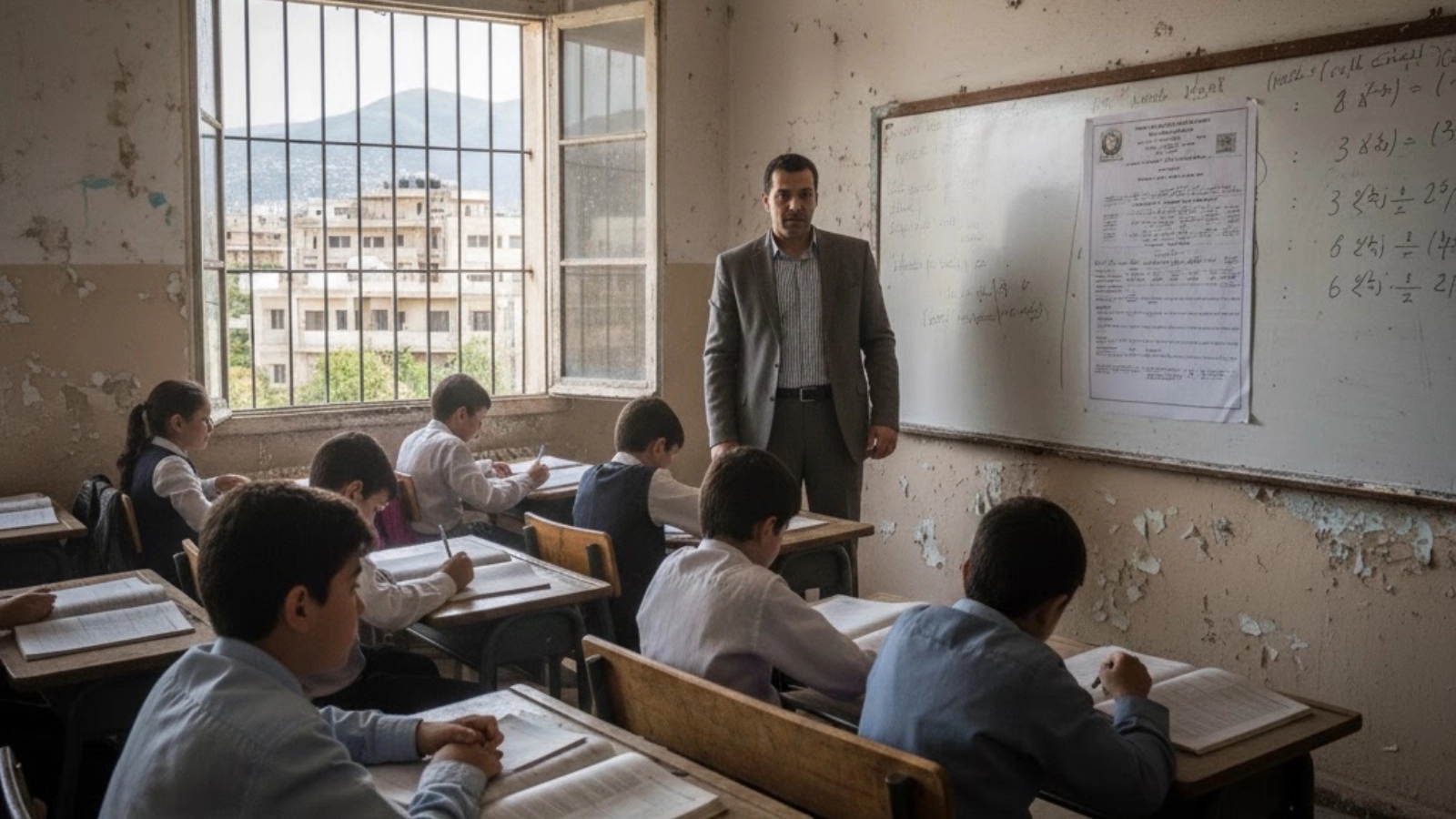
Lebanon offers a vivid illustration. In the lead-up to the official Baccalaureate examinations, pressure often reaches an acute level. Families invest heavily in tutoring and supplementary materials, not only to deepen understanding, but to secure the grade that determines access to university programs and future employment. Many students spend months in intensive preparation, living with sustained psychological tension and anxiety, while practical experience and critical thinking recede steadily into the background.
What Do We Lose When We Train for the Exam Rather Than for Life?
When a school operates according to the logic of exams rather than the logic of life, the loss is not primarily in missing facts or formulas. It lies in the student's relationship with mistakes, risk, and choice. The student learns that mistakes are to be avoided, not understood, and that safety matters more than the attempt. Over time, curiosity fades, the willingness to try weakens, and the goal of learning shifts away from understanding and discovery toward getting through without damage. Decision-making stops being a space for reflection and responsibility; it becomes unwanted exposure. Learning becomes an exercise in caution and conformity, rather than a training ground for judgment and initiative.
There is another loss, subtler but just as real, what we might call cognitive patience: the ability to stay with a difficult question, to sit alongside an unfinished idea, to remain inside a complex problem until understanding finally takes shape. This kind of patience is at the heart of deep thinking and genuine problem-solving (Bransford, Brown, & Cocking, 2000). When time is experienced as a constant enemy, students lose the texture of thinking that builds gradually and grow accustomed to fast answers that close questions rather than open them.
And finally, something essential about responsibility is lost: the ability to connect a decision with its consequences, to acknowledge a mistake, to repair what was broken, and to move forward with greater clarity. Life asks for this constantly in families, workplaces, and communities. It is rarely built by the short-term recall that exams reward.
From Passing Exams to Readiness for Life
The answer is not to demonize the exam or abolish it. It is to put it back in its proper place within a broader ecosystem of learning and assessment. The exam can remain an important landmark, but it must not become the destination. That shift requires three practical changes:
- Turn assessment into a process: Expanding formative feedback, the kind that helps students understand their mistakes and develop their thinking, rather than simply receiving a verdict, is the starting point. International research consistently supports integrating formative and summative assessment as a condition for deeper learning (OECD, 2013).
- Bring real decisions into the classroom: Students need practice in exercising judgment, not just pattern recognition. Projects, debates, simulations, and open-ended questions create spaces where learners have to interpret, weigh options, and defend their reasoning. Learning should be designed around genuine understanding, not around finding the right answer. This is the central principle of Wiggins and McTighe's (2005) Understanding by Design framework: meaningful performance, not testable memorization.
- Restore the relationship with mistakes: Building a classroom culture that treats error as part of the learning process does not lower standards; it redefines them. Quality does not mean the absence of mistakes; it means the capacity to learn from them.
None of this requires sweeping, immediate changes to official examination systems. What it requires is educational courage, the willingness to rebalance authority inside the classroom, and to redefine success as growth, not just as a number.
In Conclusion: The Exam Is a Mirror. Life Is the Real Test
An exam is not the enemy of education. It becomes dangerous only when it is allowed to become the sole measure of a student's worth.
Its real value lies not in what it measures, but in what it reveals: the learner's relationship with themselves, with mistakes, with responsibility. After everything the school says out loud about effort, discipline, and perseverance, the exam appears and shows what it has been teaching in its quieter voice: how students have learned to protect themselves, how they have learned to fear, and how often they have chosen the safety of the expected over the risk of genuine thought.
The challenge for education today is not to produce students who perform well on tests. It is to develop learners who can exercise judgment, bear the consequences of their choices, acknowledge mistakes, try again, and take a position when no model answer exists.
That is what genuine readiness for life looks like. And it is what transforms a school from an institution that produces results into one that shapes human beings (Dewey, 1938; UNESCO, 2021).
FAQs: Questions Every Educator and Parent Eventually Asks
1. When does an exam become an obstacle to learning rather than a support for it?
An exam becomes an obstacle when it is used for final judgment rather than feedback, and when life-determining decisions rest on a single result rather than on an extended learning process. Assessment research shows that exams lose their educational value when they are disconnected from opportunities to review, correct, and try again (Black & Wiliam, 2009).
2. Can students develop critical thinking in a system built around one correct answer?
Critical thinking requires multiple perspectives, questioning assumptions, and weighing alternatives, processes that are difficult to cultivate in environments built around a single model answer. Research on deep learning shows that critical thinking develops when learners are asked to justify, compare, and defend a position, not simply identify the right response (Bransford et al., 2000).
3. How does over-reliance on exams affect a student’s relationship with themselves?
When personal worth becomes tied to results, students begin to build a self-image conditioned on external success. This pattern can deepen anxiety, weaken intrinsic motivation, and turn learning into a means of self-validation rather than a way to understand the world. Motivation research indicates that this kind of conditioning limits both autonomy and the sense of self-efficacy (Deci & Ryan, 2000).
4. Why is making mistakes essential to readiness for life?
Because real life offers neither instant feedback nor ready-made answers. The ability to learn from a mistake, analyze what went wrong, and adjust course is a central skill in work, relationships, and leadership. Experiential learning research is clear on this: error is not the opposite of learning, it is one of its conditions (Dewey, 1938).
5. What does a school lose when it excludes personal judgment from learning?
It loses its capacity to prepare active citizens, not merely compliant performers. Personal judgment connects knowledge with ethical action and social responsibility. Biesta warns that marginalizing this dimension reduces education to technical training and weakens its role in shaping individuals capable of taking a position (Biesta, 2013).
6. What is the first practical change that could reduce exam dominance without waiting for comprehensive reform?
Introducing regular classroom moments in which students are asked to explain their reasoning, not simply providing the correct answer. Even within exam-oriented systems, this simple practice restores the role of thinking and judgment and reduces the reduction of learning to a final answer (Hattie, 2009).
7. What role can parents play in breaking the “grades first” culture?
Parents play a crucial role in redefining success by focusing on learning, growth, and effort rather than results alone. When a child’s value is separated from their grades, they can build a safer relationship with error and experimentation, which is an essential foundation for sustainable learning and better psychological well-being (OECD, 2019; UNESCO, 2021).
+ Sources
- Biesta, G. (2013). The Beautiful Risk of Education. Routledge.
- Dewey, J. (1938). Experience and Education. Macmillan.
- Freire, P. (1970). Pedagogy of the Oppressed. Continuum.
- Hattie, J. (2009). Visible Learning: A Synthesis of Over 800 Meta-Analyses Relating to Achievement. Routledge.
- Jackson, P. W. (1968). Life in Classrooms. Holt, Rinehart & Winston.
- Kahneman, D. (2011). Thinking, Fast and Slow. Farrar, Straus and Giroux.
- (2013). Synergies for Better Learning: An International Perspective on Evaluation and Assessment. OECD Publishing.




Add comment