



You can learn all of this by taking this test, which helps you identify your personality type as well as the patterns and traits of the people whose personalities you interact with on a daily basis. This will make communication easier for you and make social interactions less complicated because there are so many differences in people's ideas, traits, opinions, and preferences.
The sixteen personality types and their characteristics
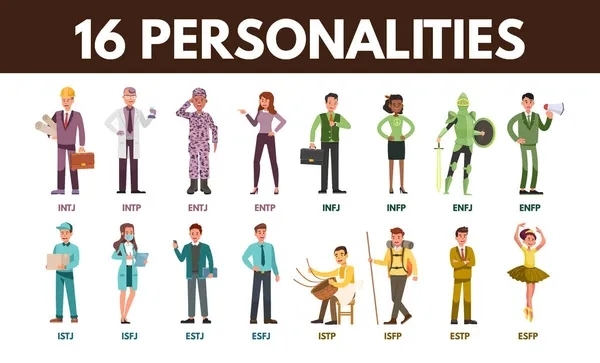
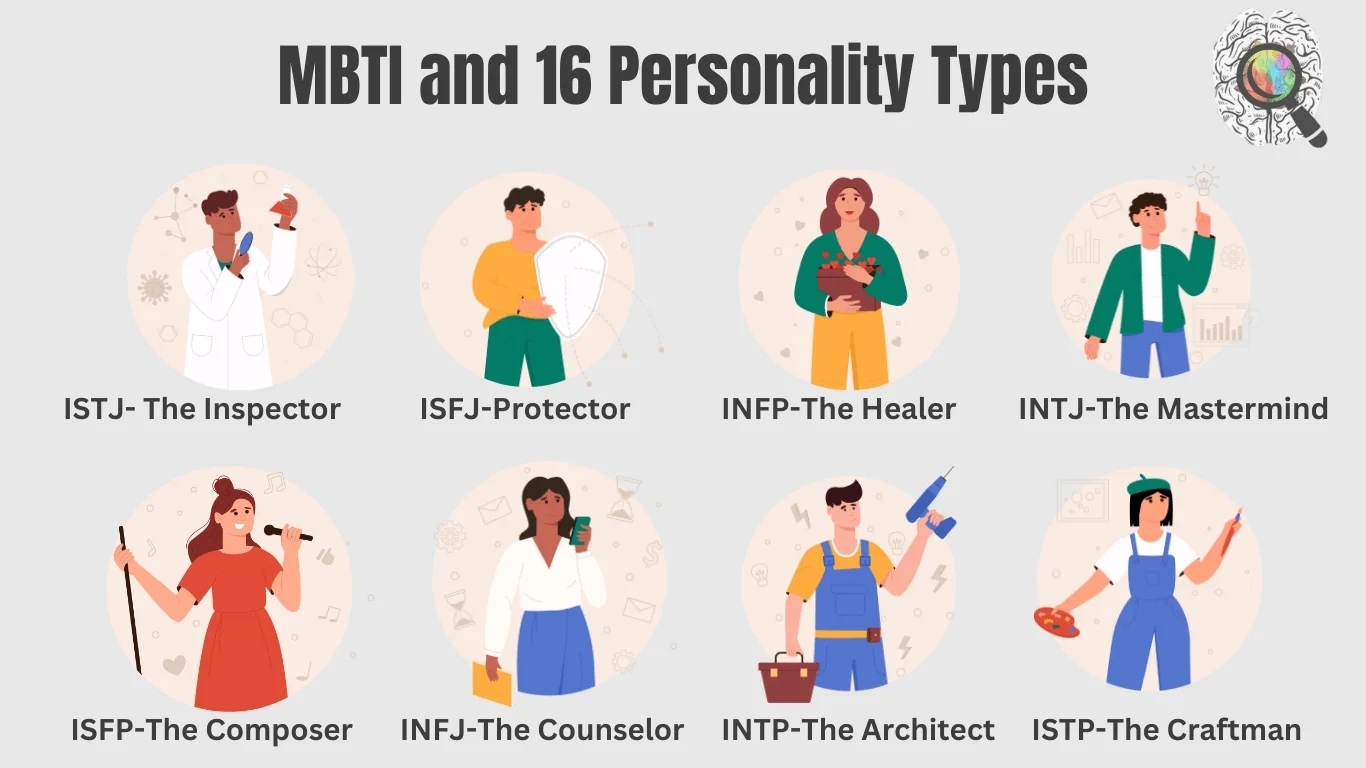
There are sixteen different types of personalities, and each personality has a symbol that represents the most likely trait from each of the four classifications. These sixteen types of personalities were identified using the dual primary classifications we discussed and the predominance of one group of preferences over another where the appropriate symbol for each character is created using the first letter of each word, as in:
- Extraversion is symbolized by the letter E.
- sensing is symbolized by the letter S.
- Thinking is symbolized by the letter T.
- is symbolized by the letter J.
- Introversion is symbolized by the letter I.
- INtuition is symbolized by the letter N instead of I.
- Feeling is symbolized by the letter F.
- Perception is symbolized by the letter p.
These motifs include:
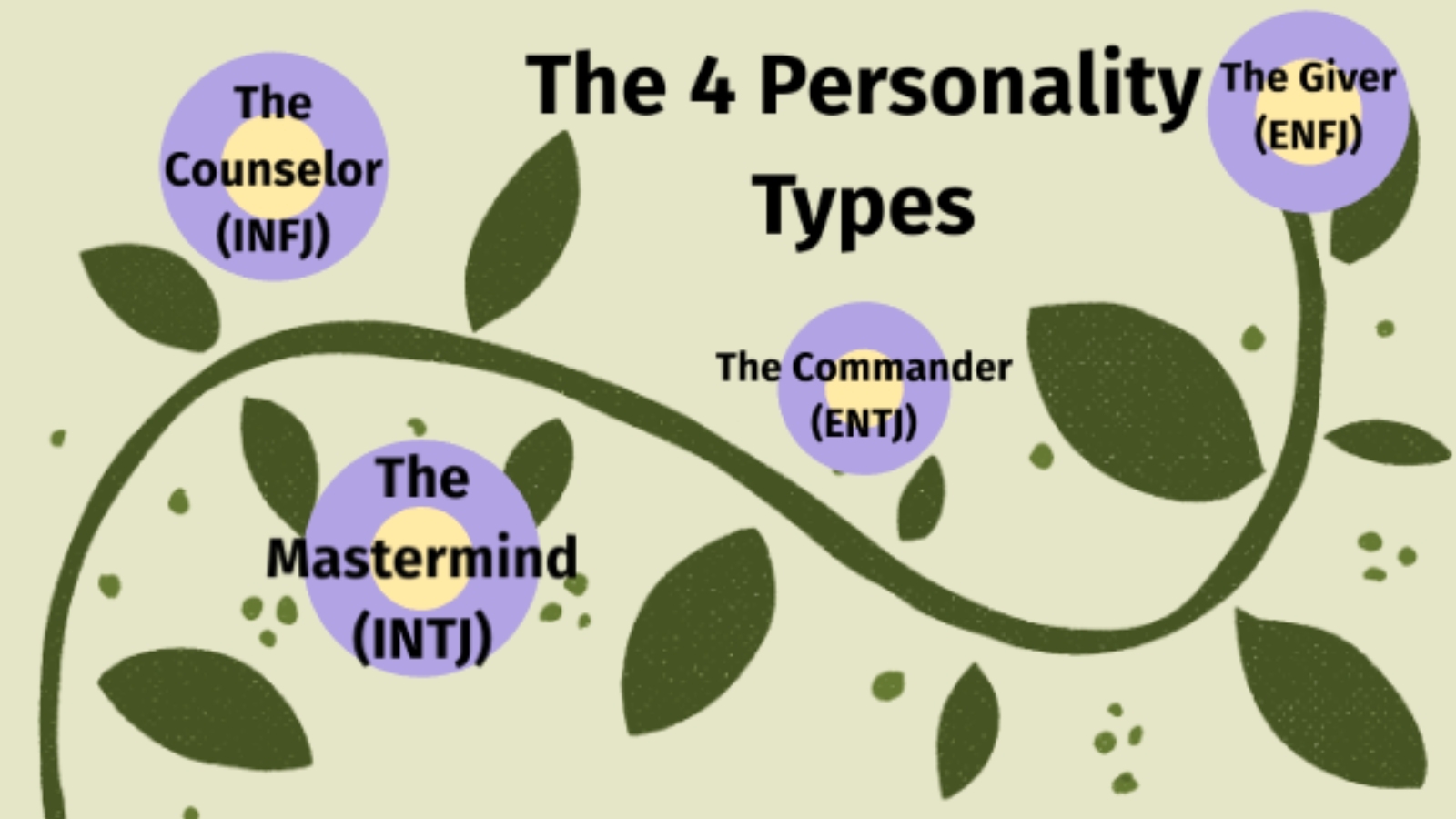
1. Advocate or Counselor, INFJ Personality
Introverted, Emotional, Intuitive, and Judging. This personality suffers from others not understanding it. They are profound individuals who steer clear of superficiality when addressing their issues.
Additionally, they each have a unique perspective on the world. They are intuitive thinkers who base their decisions and worldview on intuition. They are also perfect, kind, and polite individuals who see helping others as one of their main goals.
2. The Mastermind or Architect, INTJ Personality
Introverted, intuitive, thinks, and judges. Introverted people who find social interactions and communication draining prefer to work alone or seek out partners who can comfort them.
They are ideal employees because they value knowledge and intelligence. However, they are also perpetually perplexed by life's events because they love certainty and hate ambiguity. They enjoy planning out every situation they encounter and are always willing to share their experiences.
3. The Giving, ENFJ Personality
Emotional, intuitive, and judging. They are leaders with a very attractive personality, they have the ability to communicate with everyone and despite all differences, in addition to a great ability to influence them, and this is what makes them often act as catalysts for human growth.
And the owners of these live in imagination more than reality, and they are seduced by the future and work to discover it, and they rely on their intuition and feelings in their decisions. They are also moral, idealistic, and upright.
4. Creative Artisan or Artist, ISTP Personality
Introverted, thinks, perceives, and feels. People with this personality are generous, optimistic, and spontaneous, and because of this, their reactions are unpredictable.
They strive for justice and equality, and according to logical analysis, they are good people who learn from their mistakes and seek solutions to their problems, among other traits.
They are all somewhat ambiguous individuals who base their decisions on impartial standards as opposed to their whims and personal beliefs.
5. The Financial ESFJ Personality
Judgmental, sensual, emotional, and extroverted. People with this personality are well-liked because they strive to bring happiness to others, spread positivity, and pay attention to everyone.
They are enthusiastic individuals with the capacity to plan events and a love of taking part in a variety of activities. They prioritize spending time with their family and friends, and they avoid situations that could lead to disagreements, problems, or conflicts.
6. The Performer or Entertainer, ESFP Personality
Extroverted, Sensual, Perceptive, and Emotional. They take great care of family and friends, are kind and generous, on top of that, they are cheerful, they love entertainment. They do not plan anything and depend on luck, and they do not place restrictions on their relationships with others.
They also do not find it difficult to learn and explore; rather, you will find them enjoying it. For them, the world is nothing more than a stage, and they see everything as an opportunity to perform.

7. The ENFP personality known as "The Champion"
Extroverted, sensitive, perceptive, and emotional. This personality is distinct from others in terms of its behaviors, attitudes, and routines. It is open and leading while also having a unique perspective and a free spirit.
The owners of this personality find it exhausting to see the works through to completion. Because they prefer to run their own business and have a keen intuition about both themselves and other people, they avoid jobs, especially those in the government.
8. ESTP Entrepreneur or Doer Personality
Perceives, thinks, feels, and extroverted. They think logically, they do not like to be idle, they are interested in fixing mistakes and finding solutions and alternatives, and they draw strength from their feelings and emotions, which allows them to have good social interaction, so they enjoy spending time with friends.
9. ESTJ Supervisor Personality
Considering, judging, sensual, and extroverted. They prefer highly organized environments, they are principled, and they follow customs and traditions and everything else that makes them socially acceptable, and you will always find them ready to help, simply because they are good citizens, and they are not afraid to defend their beliefs, and they make decisions based on logic.
Their decisions, and one of their disadvantages is that they may become aggressive if others do not follow their standards.
10. ENTJ Leader Personality
Thinks, judge, extroverted, and sensual. Difficulties and obstacles are nothing more than opportunities for them to grow and an impetus to improve. They enjoy taking on responsibility, leading, and making decisions.
They are successful and professional problem solvers and solution finders. They do not isolate themselves from the outside world, but they are unable to see things outside of their own world.
11. INTP Thinker Personality
Introverted, intuitive, thinking, and perceiving. These characters are described as the most logical characters ever. people are moody, their personalities are very complex, and as a result they may detach from reality and lose sight of the world around them.
but they are creative and talented meditators who analyze ideas differently and innovatively, and they are the personalities who are credited with most scientific discoveries and innovations over the years, their ideas are creative and different, they are able to read people and understand them.
12. The ISFJ personality type known as the Educator or Advocate
Introverted, Sensual, Emotional, Judging. You can rely on these kind, generous, and loyal individuals because they don't ask for favors, give generously in return, perform their jobs flawlessly, are compassionate and helpful, and are always willing to lend a hand or offer support. However, they are reluctant to express their emotions out of concern that they will burden others with their problems.
13. The Dreamer, ENTP Personality
Extroverted, Intuitive, Thinks, and Perceives. They are smart people who enjoy discussions, avoid fleeting and superficial conversations, dislike large gatherings, are regarded as rare personalities, seek to influence others, understand them, analyze them, and understand the systems that surround them. They are also people who enjoy being intellectually and rhetorically challenged.
14. The composer or artist, an ISFP personality
Introverted, sensual, emotional, perceptive. Positive individuals who value art and strive to make the most of each day. They have no qualms about experimenting. Instead, they are unconventional and love adventure.
They are also kind and well-liked by friends and family, and they do not despise social interactions. You may initially struggle to interact with them because they are unfamiliar, but eventually you will have the ideal friend.
15. Observer or Logistician, ISTJ Personality
(sensual, thinking, judging, introverted) serious and formal if not close to them, and they are characterized by calmness, accuracy, and patience, and they are also serious, responsible, organized, and traditional people who are proud of professional ethics and hard work.
Their qualities result from a mixture of introversion, sensing, thinking, and judgment, and they are people who are misunderstood. One of these personalities' most notable strengths is that they are realistic, logical, organized, and focused on the present, while their most notable weakness is that they blame others.
16. The Idealist, INFP Personality
Introverted, intuitive, emotional, and perceptive. They constantly strive for perfection and idealism, lose themselves in their dreams and fantasies, spend the majority of their time by themselves, and do not typically or particularly enjoy bragging about their accomplishments.
How can I determine which personality type I am?
We all want to know what our personality type is because personality types vary widely and share certain traits. The following is the response to the question: "How do I know what my personality type is?"
Finding out the different personality types can be done using a variety of techniques, some of which include:
1. Psychological tests
To learn more about personality types, you can take a number of psychological tests online. For accurate results, search for tests like the Big Five personality test or the Myers-Briggs personality test.
2. Psychological counseling
Consulting a psychologist is another well-liked method for understanding personality types. To help you identify and comprehend your personality type better, you can speak with a counselor or a life coach.
3. Observe your behavior and interactions
Some people use observation of their behavior and interactions to ascertain their personality types. If you want to identify your personality type, pay attention to how you behave and interact in various contexts and try to analyze these behaviors to see if they point to a particular personality type.
4. Reading and learning
To learn more about personality types and to determine whether a particular style fits your personality, you can read about them. You can also learn about the distinguishing characteristics of each personality type.
Knowing your personality type and the personality types of those around you can help you better understand yourself and interact with others. You can also use this knowledge to develop your life and career plans.
Personality style test
There are several psychological tests available on the Internet to identify personality types and personality types, but the most well-known of these tests is the personality style test.
1. Myers-Briggs personality test
This test determines your personality type based on four factors: how you use your energy, how you gather information, how you make decisions, and how you interact with other people. You can take this test for nothing online.
2. The Big Five Personality Test
This test to identify personality types measures openness, tenderness, emotional stability, responsibility, and openness to experience. It is available online and is free to take.
3. DISC Personality Test
This personality type exploration test assesses four essential personality traits: agreeableness, authority, influence, and stability. Online testing is available, but it costs money.
4. Enneagram Personality Test
This personality type test identifies nine distinct personality types and provides insight into a person's actions, inclinations, emotions, and thoughts. You can take this test for free online.
It is crucial to remember that these tests only give an overall picture of the major personality traits rather than a precise indication of personality types. Additionally, using this knowledge as a springboard will help you better understand your own psychology and interact with others.
The Myers-Briggs test: What is it?
The Myers-Brigger Index (MBTI), created by Isabel Myers and her mother Katherine Briggs, is a self-report questionnaire that identifies a person's personality type, strengths, weaknesses, and qualifications. It was based on Carl Jung's theory of personality types, the father of analytical psychology.
The characters are named accordingly because this indicator depends on emphasizing and demonstrating a dominant trait that is present in a person as being his fundamental nature.
As a test and an experiment designed to help us better understand ourselves, identify our traits, and shed light on aspects of our personalities that we are unaware of or do not recognize, this test cannot be completely confirmed, credible, or trusted. Due to its purported predictive abilities and limitations in psychological and scientific areas, such as its incompleteness and low reliability, this indicator is considered pseudoscience despite being similar to some psychological theories.
Myers developed this test over the course of twenty years. It is important to note that the analyst Carl Jung classified the personalities according to extroversion or introversion, inquiry or intuition, thinking or feelings, and Myers added judgment or perception to them.
Today, anyone can take the test, which is free and available online, to learn more about their qualities and understand themselves, turning it into a roadmap for achieving success.
The results of this test can be used to determine a person's personality type by revealing the percentage of each classification that makes up their personality.
Each classification has two characteristics that are related to the person, his or her choices, and decisions, as was mentioned above. We will examine each category in turn to further clarify the concept:
- Extraversion or Introversion: If you focus your energy on other people, your surroundings, and external things, you are an extrovert. However, if you prefer to spend time alone in your head, you are an introvert.
- Thinking and Emotions: This category is concerned with how decisions are made. Do you consider the feelings of those around you when making decisions, or do you rely on logic?
- Inquiry and intuition: Do you like to add meaning to things and interpret things in your own way, or are you happy to accept only the bare minimum of facts?
- Perception and judgment: This category focuses on how you relate to the world around you and how much this relationship affects your choices.
Conclusion
The Myers-Briggs Index is not only general information; It is also a door to knowing yourself deeply and knowing how you are affected by the environment around you and how it affects it, and it helps you understand yourself and others better.
We all need to understand and analyze our personalities in order to know the extent to which we use our reason or our feelings, and the extent to which we rely on our intuition, our senses, or on logic in making fateful decisions.




Add comment