



By understanding the six communication languages, you can adjust your communication depending on the learner's style to build bonds and relationships and see better learning outcomes.
Whether you are a trainer, coach, mentor, or learning and development professional, you have certainly come across a time when you find it difficult to get your point across or learners fail to understand it. This can be frustrating and time-consuming and can lead to poor results and failure to transfer learning. But you have the power to change this; it all depends on how you speak in a language that matches the learner's personality type.
Our personality structure has a strong influence on how we perceive the world around us and how we relate to others. When we match the language of communication with the language preferred by the learners, we communicate our message to them while building trustworthy relationships with them. The Practical Communication Model (PCM) is one of the tools that is successfully used for this.
When we know the language that learners prefer and how to use it, we can communicate with them better, and it becomes easier for us to get our message across.
The Six Personality Types Used in the Practical Communication Model
The Practical Communication Model is a behavioral communication model that demonstrates individual personal differences. It has been endorsed by NASA and has been used successfully to build better self-awareness, improve communication, manage tension and conflict, strengthen relationships, and develop teams.
According to this model, we all have six different types of personalities within us, arranged according to the preferred type. Our basic type can be distinguished at birth or during the first few months of birth, and then the remaining five types are arranged starting at the age of seven, according to the principles of developmental psychology and social influence.
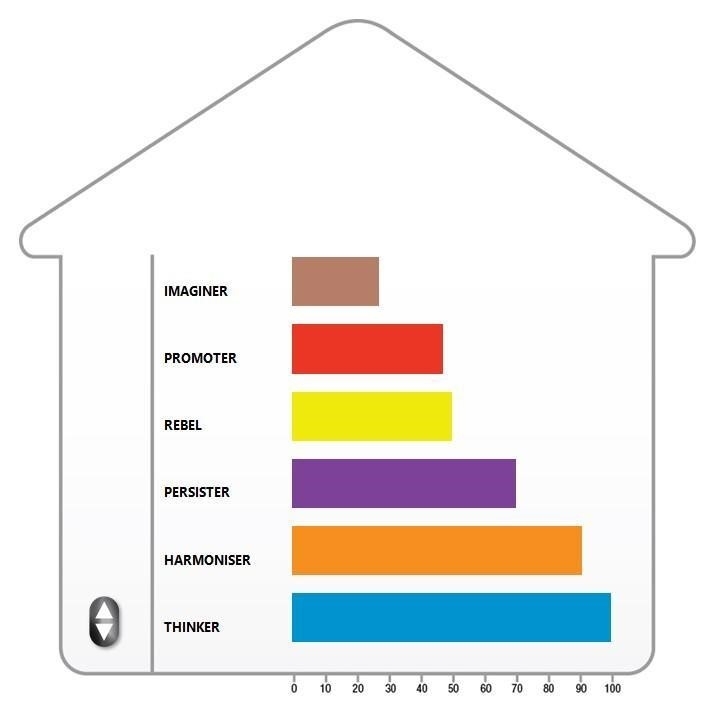
We often express this model using a six-storey building diagram, as shown in the picture above, which helps us visualize the formation of each unique personal structure.
The types of personalities shown in the picture from bottom to top are: thinker, harmonizer, persister, rebel, promoter, and imaginer.
The model discusses people's personality types rather than people's types. Personality models that talk about people's types inherently advocate separation, bias, a sense of preference, and prejudice.
The six distinct types of personality within us, along with their traits and strengths, are summarized in the table below:
|
Personality Type |
Personality Traits |
Communication Language |
Personality Strengths |
|
1. Thinker |
|
Thoughts |
|
|
2. Persister |
|
Opinions |
|
|
3. Harmonizer |
|
Emotions |
|
|
4. Imaginer |
|
Inaction |
|
|
5. Rebel |
|
Reactions |
|
|
6. Promoter |
|
Actions |
|
The Practical Communication Model provides valuable insights into the ways in which these types affect the way we think, feel, and behave. Each type has its own perceptual filter, which is the preferred way to see the world. Since we have all six types, we have the ability to appreciate and communicate with any other type.
The Six Communication Languages
When communicating, the Practical Communication Model has six distinct languages called cognitive reference frames, or cognitive languages. The concepts discovered by Dr. Taibi Kahler were the language that words hide because the communication process often carries more information than the content transmitted.
When we learn to recognize other people's preferred cognitive language and how to use it, we communicate better with them. It's easy for us to get our message across. This way, we'll invite them to hear and remember more about what we say to them, so they're more likely to communicate with us.
1. Thoughts: Thinker's Language
The thinker seeks to understand the world by organizing, sorting, and classifying the information they receive. They will talk about facts, data, and characteristics, ask questions about people, time, place, reasons, and methods, and appreciate others who use this language with them.
Some Examples of How to Communicate with a Thinker:
- Provide relevant timelines for the thinker at the beginning of the day, respect them, and tell them, “This is our schedule for the day; these are our breaks, etc.”
- Provide data, facts, percentages, and graphs whenever possible when sharing information.
- Willingness to answer questions, as the thinker has a natural desire to understand the details and the logical relations between the things they learn.
- Use phrases such as “I think,” “what are the options?" “does that mean?" and “will you help us develop a plan?"
2. Opinions: Persister's Language
Opinions, judgments, and the expression of beliefs are usually habits of a persister, as they see things from the perspective of purpose, values, and trust, all of which are chosen through their personal values, beliefs, and conscience.
Some Examples of How to Communicate with a Persister:
- Ask their opinion.
- Avoid contradicting their opinions. If you disagree with them, you can say things like “May I make point?” or “Thank you; I'll think about your suggestions.”
- Use phrases such as “in my opinion,” “should,” “believe,” “respect,” “values,” “commitment,” or “dedication.”
3. Emotions: Harmonizer's Language
A Harmonizer perceives the world by feeling people and situations, using their heart as their compass. They care about their relationships and for others, and a comfortable atmosphere is important to them.
Some Examples of How to Communicate with a Harmonizer:
- I'm glad you're present in my training today.
- I'd love for you to feel comfortable today. I'm here if you need anything.
- I'd love to hear your thoughts on this.
- Use expressions such as “I feel” or “I am comfortable with.”
4. Inaction: Imaginer's Language
Imaginers see the world by thinking about what is happening, and for them, life is an open space that is ideal for imagining possibilities. Although they may seem calm and seemingly inactive, they are energetic internally and respond very well when they receive clear instructions.
Some Examples of How to Communicate with an Imaginer:
- Clearly tell them what you want them to do in the activities.
- Give him time to visualize or imagine how they can use what you are teaching them.
- Give them clear instructions using some words such as “imagine,” “think,” or “visualize.”

5. Reactions: Rebel's Language
The rebel values feelings of happiness and looks at the world by responding to people and situations with likes or dislikes, as they act more spontaneously than they think. They respond to situations more than take responsibility. They are also creative, not analytical. They are energetic and optimistic people who are always up for some fun.
Some Examples of How to Communicate with a Rebel:
- Allow them to enjoy themselves while learning.
- Include some fun activities during the training.
- Play music during breaks.
- Use phrases such as "I like and don't like" or "amazing," funny phrases, and slang words.
6. Actions: Promoter's Language
The promoter's initiative and actions appear through the implementation method as they work to achieve things, and then you hear them say, "Let's continue working." What distinguishes them is taking the initiative and getting things done easily. They will find a way to overcome obstacles and will always be adaptable and self-sufficient as they rise to the challenge.
Some Examples of How to Communicate with a Promoter:
- Include a lot of interactive exercises.
- Sparking the spirit of challenge in the promoter.
- Using phrases such as “bottom line,” “best opportunity,” “you need to make this happen," and “enough talk and let's get to work," which means trying to include a lot of verbs in your speech.
In Conclusion
The next time you find it difficult to get your point across when offering training, coaching, or mentoring, remember these six communication languages and think about the style that works best for the person. By adjusting your choice of words and the way you communicate, you will have a much better chance of being heard and forging stronger relationships that will inevitably lead to better learner outcomes and development.


Add comment