


Teachers classified him as a failure as a child. He even did poorly in math. He was suffering from ADHD, as he was a dreamy child with a weak memory.
The editor-in-chief of the Kansas City Star dismissed an artist from his cartooning position in 1919, citing him as "lacking imagination and having no creative ideas."
This artist was Walt Disney, who went on to become the owner of the most well-known animation company called "Disney." Walt Disney was a very creative man, so much so that he turned his failure into a brilliant success by creating the iconic cartoon character Mickey Mouse.
The story of well-known motivational speaker Nick Vujicic must also be mentioned. Vujicic was born with no limbs. Throughout his early years, he struggled with his disability and even attempted suicide.
Fortunately, he changed his situation because he strongly loved his parents. Millions of people worldwide are inspired by how he used his weaknesses to his advantage.
There Is No Shame in Having Some Weaknesses; What Is Shameful Is Giving in to Them
You have two choices: Either accept your weakness and see it as a barrier or obstacle, or turn it into a strength and learn how to use it as a starting point for your success. Know that you will not be able to change the circumstances you are going through; rather, use them to your advantage.
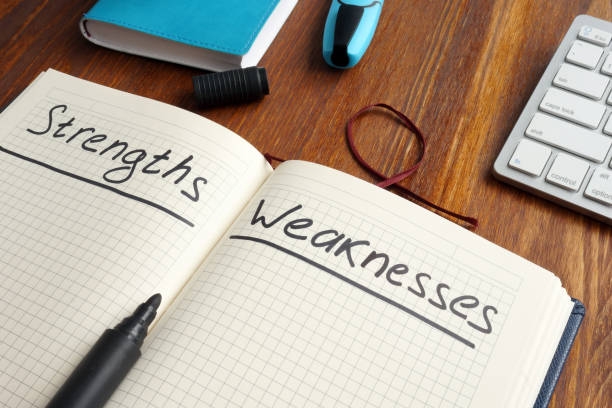
Should You Focus on Your Strengths or Weaknesses?
This is the most common question asked regarding self-development and improving weaknesses. Concentrating on your strengths and expertise is important, but it is similarly important to address your weaknesses.
Imagine that you are driving a car with the handbrake pulled. In this situation, you can depress the accelerator pedal, but until you release the hand brake, the car won't move quickly or smoothly.
Releasing the handbrake and not allowing it to stop or slow you down is similar to improving your weaknesses. While driving a car, you shouldn't give the handbrake your whole attention. The same applies to life; you should focus on your strengths rather than your weaknesses.
Simultaneously, you need to improve your weaknesses to prevent them from becoming a barrier to your progress. Although focusing on your strengths is beneficial, strengthening your weaknesses will yield tremendous results.
How to Turn Your Weaknesses into Strengths?
To turn weaknesses into strengths, follow the following steps:
1. Realizing and acknowledging your weakness
How can you fix an item if you don't know it's broken? The first step in improving your weakness is to realize that it exists so you can make deliberate efforts to overcome it.
2. Good preparation
Once you know your weaknesses in your life, prepare yourself to overcome them. For example, you should prepare for the trip and memorize the path by heart if you struggle with determining destinations.
Take a picture of your parking spot if you have trouble remembering where you parked your car. The key is to prepare yourself to overcome challenges; in other words, to take countermeasures.
Likewise, when you have to give a presentation to a group of clients, prepare and practice it several times before the presentation. Not only does preparation boost your confidence, but it's also one of the best ways to improve your weaknesses.
3. Taking advantage of the strengths of others
Sometimes, it's better to find others who possess the skills you lack and take advantage of them, as you won't have to do everything yourself. You can delegate tasks you're not good at to people who are.
Remember that successful business people and pioneers are people just like the rest of us, with flaws and strengths. Don't assume they are flawless. Great success comes to those who take advantage of other people's strengths.
Upon beginning his career at Apple alongside Steve Wozniak, Steve Jobs possessed no prior knowledge of technology, programming, or design. However, he relied on Wozniak's expertise as a computer engineer to design Apple's first computers.
The same thing happened in Disney. Walt Disney was the creative force in the company, while Roy Disney was responsible for financial matters. Walt benefited from Roy's financial knowledge, while Roy relied on Walt's creativity to grow the business.
We conclude that in order to succeed, you need other people's assistance and support as well as their skills and knowledge. Therefore, those who take on too much responsibility fail because they burn out from doing so much. Using the strengths of others is essential if you want to grow and progress your business instead of operating as a solo entrepreneur.

4. Confronting your weakness and moving forward without fear of the consequences
Without the willingness to confront your fears and pursue your goals, you will never be able to improve yourself. You will never grow if you're unwilling to take risks and step out of your comfort zone.
Lack of experience often doesn't show that we are weak in some areas; rather, it shows that we lack the bravery to face those things. For example, many people see their inability to be creative in their writing as a weakness. However, if they can overcome this fear and write daily, their abilities will gradually improve.
Therefore, if you think that you lack writing skills, create a blog and post 500 words a day. After about a year, It will become apparent that writing distinguishes you and that words come from your hands onto paper in the same way that spoken phrases come from your lips.
You must understand that one must work hard and aspire to succeed; success does not just happen to people. This implies that you should resist the idea that you cannot master a certain skill. Recognize that professionals were once beginners in their field. For example, if you believe that you lack basketball talent, consider how Michael Jordan went from being a mediocre player to a bright star.
So, face your weaknesses and do not avoid them. Do not lose faith in yourself, and do not let your limiting thoughts prevent you from becoming the person you want to be.
5. Mastering what you do
You are not required to be good at everything, and you will never be able to be. However, some skills and tasks are worth learning for you to master what you do.
The founder of China's biggest e-commerce platform, Jack Ma, knows nothing about programming and doesn't even know how to build a website; all he needs to know is how it functions.
To turn on the lights in your house, you don't need to be an electrician or understand how electricity operates. All you need to know is the fundamentals. This holds true for both life and work. After that, you can outsource or employ people to complete your tasks.
Here, the issue lies in the strategy vs the technical knowledge. Employees can perform technical tasks, but to succeed, you need to have a clear, strategic vision.
In Conclusion
Focusing on your strengths is key, but you should not ignore your weaknesses completely. Improving your weaknesses might sometimes lead to better results and success. You do not have to learn everything, but you should not let your weaknesses prevent you from doing your job. Follow the previous tips to turn your weaknesses into strengths, and you will become a more powerful person.



Add comment