


In general, societies need conscious minds capable of adapting to this change, and any community builds that type of mind through education. Education's primary tool to achieve this is supporting the curriculum with appropriate teaching methods.
The curricula have become based on the need to provide the learner with higher thinking skills and to get out of the mentality of indoctrination that existed in the old curricula to curricula with deeper and more lasting information that lasts for a long time. Many teaching strategies and modern methods have emerged to teach students how to think.
The most important is the strategy of mental maps that contribute to understanding and assimilation of concepts and information, clarify the cognitive and skill structure of the learner, and design a simplified structure of complex knowledge in an interesting educational way that serves the learning and teaching processes alike.
These maps have contributed to creating an interactive learning environment that aligns with the nature of the tendencies and orientations of learners. They are a tool that helps to understand all sciences in a simple way that is easy to visualize, understand, compile, arrange, classify, store, search for, retrieve, shroud their relationship with others, and project them to real life.
Introducing Mental Maps
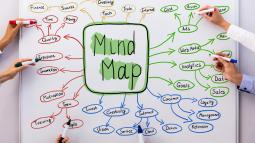
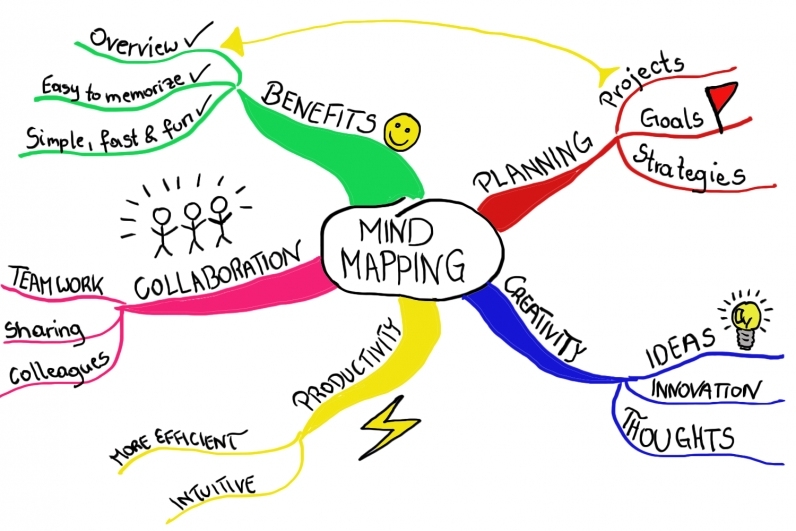
It is one of the modern teaching strategies containing the associative network that clarifies the elements of the subject and establishes the facts and information in the student's mind by reducing many pages of data into a single organization map. The map includes a single central concept from which several main ideas branch. The information starts from the most comprehensive to the least comprehensive and contains symbols, colors, and graphics.
The idea of mental maps was introduced by Tony Buzan, founder of the World Memory Competitions and holder of the highest degree in creative intelligence, in the seventies of the last century. He defined it as "colorful visual forms to take notes and can be done by one person or a group of people. There is at the heart of the form a central idea or image, and this idea is then explored by branches that represent the main ideas." He also said that the system would expand the field of the individual's use of language, words, and images for remembrance, creative thinking, and problem-solving.
Education researcher Shaimaa Hassan defines it as "one of the strategies of active learning works to arrange information in a way that helps the mind to read and remember information instead of traditional linear thinking." Mental maps have many synonymous terms, including cognitive maps, brain maps, concept trees, subject trees, and mental charts.
Mental maps are very wonderful tools in the organization of thinking. It is an expressive visual tool used to summarize important information and ideas and interrelated elements and works to acquire, organize, classify, and store a vast amount of information, and allows easy return to it and thus the ability to use the information to reach good decisions and deal with new problems faced by the learner.
We draw mental maps to increase the speed and efficiency of the lesson, take notes, summarize the subject, expand the circle of ideas and organize them, expand existing knowledge, enhance scientific and critical analysis skills, and develop research and investigation skills.
Objectives of Mental Maps
- Exploiting the energy of the mind effectively and successfully.
- Obtaining a comprehensive and complete view of the subject under study.
- Linking information with mental connections so that the learner can deal with it quickly.
- Feeling self-confident away from the psychological pressures that result from the lack of understanding of the scientific material.
- Getting rid of problems of forgetfulness, inattention, mind wandering, lack of concentration, and inability to assimilate or organize and arrange the information.
- Saving time and effort for the learner and increasing their productivity and efficiency.
The method of preparing mental maps
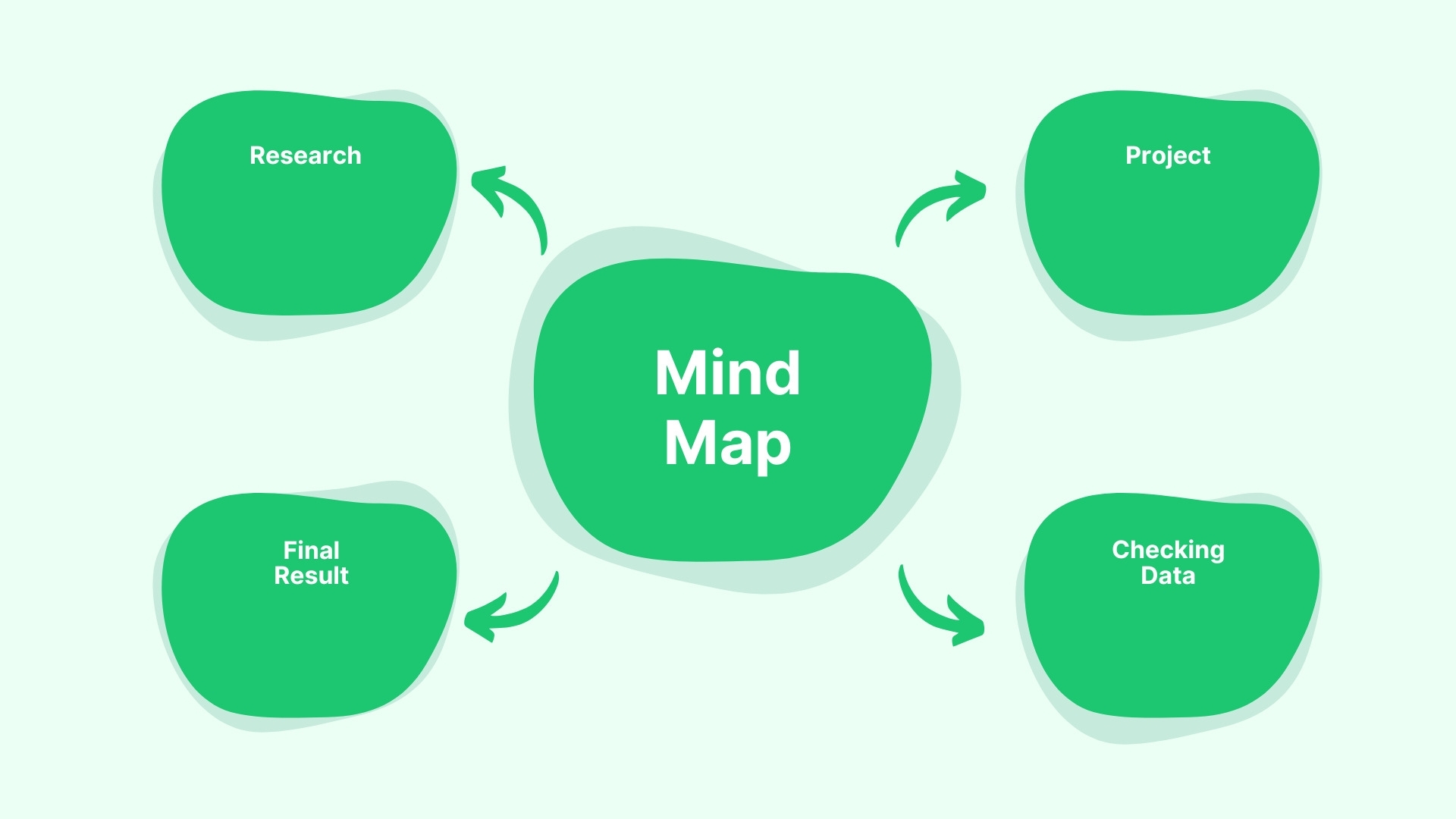
Making the mental map can be explained simply by placing a headline for the topic representing the center in the middle and then identifying the main headlines related to the main topic and branching off from the subheadings. To attract the learners, the teacher who prepares them adds drawings and colors to reflect their artistic taste and touch.
Types of Mental Maps
1. Binary Mental Maps
They are maps in which two radiant lines emanate from the center.
2. Composite Mental Maps
This type includes more than three and less than seven branches, and it helps to acquire essential skills such as classification and ranking.
3. Group Mental Maps
This type is designed by a group of individuals in the form of groups.
4. Electronic Mental Maps
This type is designed using a computer; there are special programs for preparing mental maps.
What are the educational benefits of Mental maps?
- They organize the cognitive structure of the teacher and the learner.
- They review information in an orderly and systematic way that is entrenched in memory and held for a long time.
- Mental maps account for individual differences; they allow each individual to formulate the subject in their way and according to their abilities after watching them.
- They collect the subject's molecules and draw a complete picture.
- They help the teacher present the lesson effectively, minimizing the narration of information by memorization.
- They deepen cognitive skills: classification, comparison, analysis, elicitation, synthesis, abstraction, etc.
- They deepen using knowledge skills such as decision-making, problem-solving, innovation, and invention.
- They integrate new knowledge and experience with old ones in building new knowledge.
- They place as much information as possible on a single sheet of paper in a concentrated form; you can turn long lists of rigid information into a structured graph in attractive colors, making it easier to understand and memorize.
- They allow the learner to put all their ideas in one paper and look at them with a holistic view that enables them to decide.
- They increase the learner's concentration, attention, and long-term retention of information; this is reflected in increased academic achievement.
- They help accelerate learning and knowledge discovery faster by drawing a diagram that illustrates the main idea and its sub-ideas.
- They achieve the learner's quick review goal when they do not have much time to review.
- Mental maps are easy to update yearly, ensuring they constantly keep up with scientific and technological changes.
- They prevent boredom and enable the teacher to balance speaking spontaneously and giving a well-constructed presentation.
- They develop visual, imaginative, and holistic thinking.
- Through it, the teacher can manage time well and adapt it to the time allocated for the lesson.
- They lend pleasure and excitement to the scientific material and develop the ability to employ the skill of drawing.
- Finding relationships between variables and concepts and linking them.
Uses of Mental Maps in Education
- Prepare lectures and lessons faster instead of writing down their words entirely.
- Explaining and presenting lessons. The Mental map is prepared with details related to a specific topic; it is presented to learners by a computer or a projector.
- The possibility of using it in exams and tests if the learner's understanding of the scientific material is to be measured, as it reveals the level of knowledge, whether deep or superficial.
- Taking notes: The learner can take notes related to the subject of the lesson through mental maps, and you can organize them in a way that makes it easier for the learner to return to them in time of need.
- Its actual usefulness when used with modern teaching methods, such as creative thinking sessions, brainstorming, analysis, planning, imagination, innovation, renewal, and organization, or arranging, summarizing, diagnosing, studying, reviewing, preparing lesson plans, decision-making, improving memory, problem-solving, presentations, detailed diagrams, and organizational charts.
In conclusion
Technological development has led to the emergence of modern methods and ways of teaching to achieve the required learning. It has increased recently in the educational circles about mental maps, especially in light of the great importance and benefits they gain. Mental maps are a way to arrange information, whether new needs to be memorized or a precedent exists in the human mind and must only be arranged.
Although the idea of these maps is familiar, they have undergone several modifications over time until there are electronic maps, and the opportunity to benefit from them is available to everyone in all fields. Mental maps are necessary for creativity, remembering, increasing understanding, productivity, and satisfaction. They benefit learners of all ages as they develop, organize, and present their ideas better.


Add comment