



Nevertheless, we will demonstrate in this post how to read and comprehend far more quickly than you do now. But before you begin, there are a few things you should expect.
Let's start looking at what you can achieve from a scientific point of view.
Is Speed Reading an Effective Skill?
In his book, The Speed Reading Book, author Tony Buzan presents readers with some astonishing speed-reading stories that will make them eager to learn this skill.
Buzan offers two examples of characters known for their passion for speed reading: former U.S. President John F. Kennedy. Kennedy), and Franklin D. Roosevelt (Franklin D. Roosevelt, Kennedy, was known for his ability to read 1,000 words per minute, compared to an average reading of 284 words per minute for most of us.
Sean Adam, director of research at the Alpha Learning Institute, set a world speed reading record of 4,450 words per minute.
But it may seem impossible to read carefully so quickly, as it is only enough to turn the pages of a picture book! In fact, Sean Adams and former US President Kennedy taught themselves how to speed-read from A to Z, and their beginnings were as slow as the average person at 284 words per minute.
You'd be surprised if you could read so fast, wouldn't you?
From a scientific point of view, we cannot read more than 500 words per minute with complete comprehension; where are we from science to question it?
But how do you explain legal and advertised speed-reading competitions that assess people's reading speed based on how much they understand? Some of these readers have been able to read thousands of words, so with these opposing views, it is difficult to conclude without bias. Continue reading with us, as we may agree.
Adaptable Mind
Other accomplishments besides reading, made quickly by people who began as ordinary people and gradually achieved more impressive mental processing speeds, exist.
Some people memorise a lot of information in a few seconds, while others can make direct mental calculations of large numbers, not to mention talented piano players who can play complex musical compositions. All these examples make us wonder how to do that without denying the existence of those capabilities.
The most important thing to remember is that training makes you perform better at any skill. Depending on how your mind reacts to your activities, you will undoubtedly get better at reading and comprehending texts fast if you exercise that skill.
When you force yourself to exert your maximum energies and try to do something faster than you used to, you are telling your brain that you need to accomplish all the tasks you perform faster or better and force your brain to adapt because this is how our brains develop.
However, the issue remains: Is it possible for the majority of people to read at 1,000 words per minute and still understand what they are reading? Of course not, given some of the limited abilities of the human brain, not to mention that many will not accept spending the thousands of hours it takes to reach this level.
A person cannot reach those extraordinarily high speeds without committing to a training period that may take up much of their time and is not worth the effort.
Positively, you will inevitably double or triple your reading speed if you are a casual reader without using any speed-reading strategies. That will probably happen if you change your reading habits.
In this article, you will learn how to read up to 500 words per minute with 100% comprehension. This sounds fast, doesn't it?
You can skip that pace, but you line up words selectively, with the ability to understand information differently. So, when you select, you only capture the most critical information and eliminate words and syllables that you consider less important.
For now, let's focus on how to master fast reading in the right way:
1. Start with a set of words
First, you need to realise that your brain can read or absorb the information contained in 3-5 words together instead of reading and absorbing the meaning of each word alone, so instead of spending a fraction of a second on each word in the line, in the figure below:
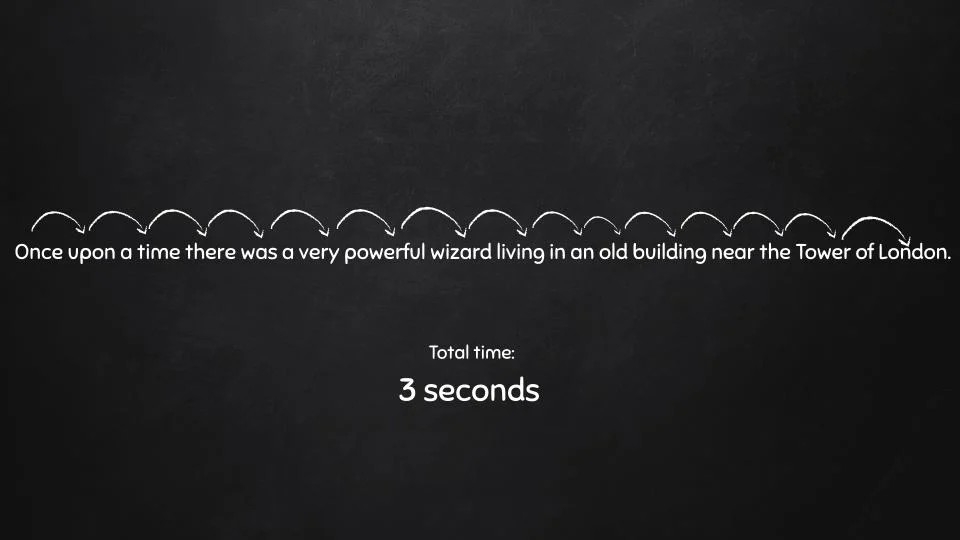
Invest the same fraction of a second in reading a set of words as shown in the following figure:
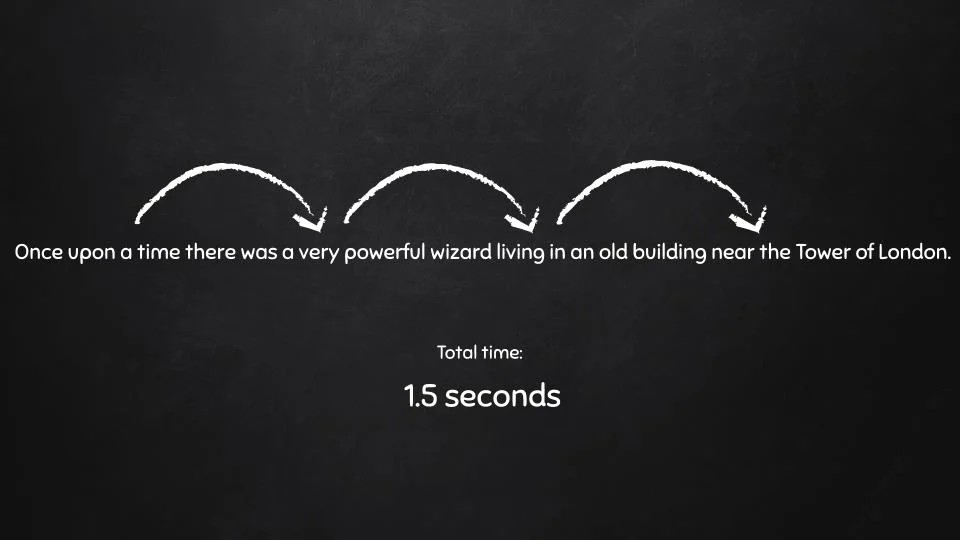
You may think that your understanding will be affected by speeding up in this way, but rest assured, nothing like this will happen. When you focus your attention on one word at a time, your mind will try to absorb each word separately, but it is not the words that give any meaning when they are alone; their meeting with each other gives the desired meaning. Here is the same sentence, but the words are put one by one:
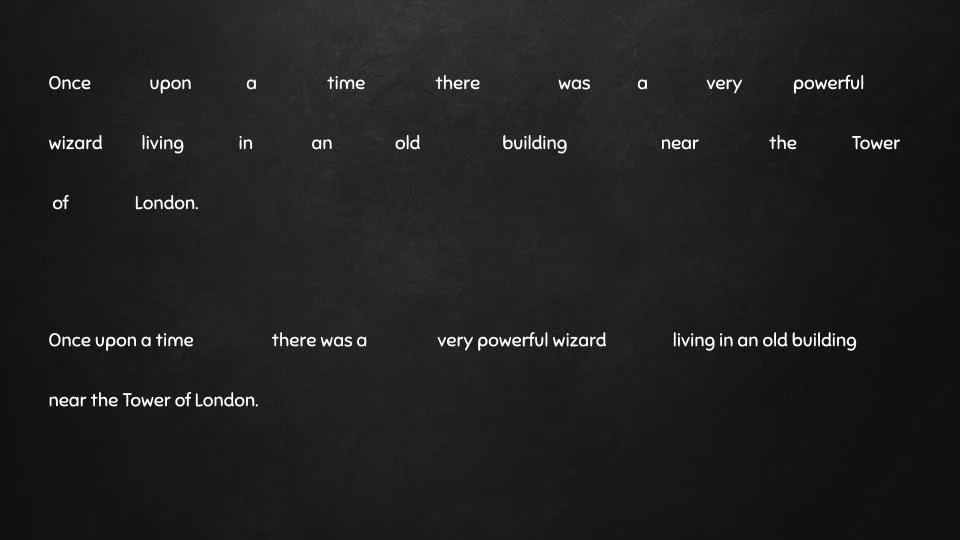
Which of these two versions is understood faster? The answer is clear: grouping words into meaningful packages helps readers read and comprehend information more quickly than focusing on individual words.
Eliminate outdated reading habits
If you want to eliminate this habit, stop looking at each word separately when reading, as the reason for our slow reading goes back to elementary school. When we learned how to read at an early age, we first learned to look at each letter separately, and then we used those letters to make up words. Over time, as this process accelerated, we realised we could take a quick look at one word as a whole and that the composition of those letters gave meaning.
But for one reason or another, the reading process stopped there, and no one actually taught us that we could move to a higher level and absorb a large group of words from just one look, and we did not seek to develop this skill anymore.
But that doesn't mean you should stop trying, and all you have to do is get familiar with the concept of fovea centralis and take advantage of it.
The image below shows three types of peripheral vision that we have:
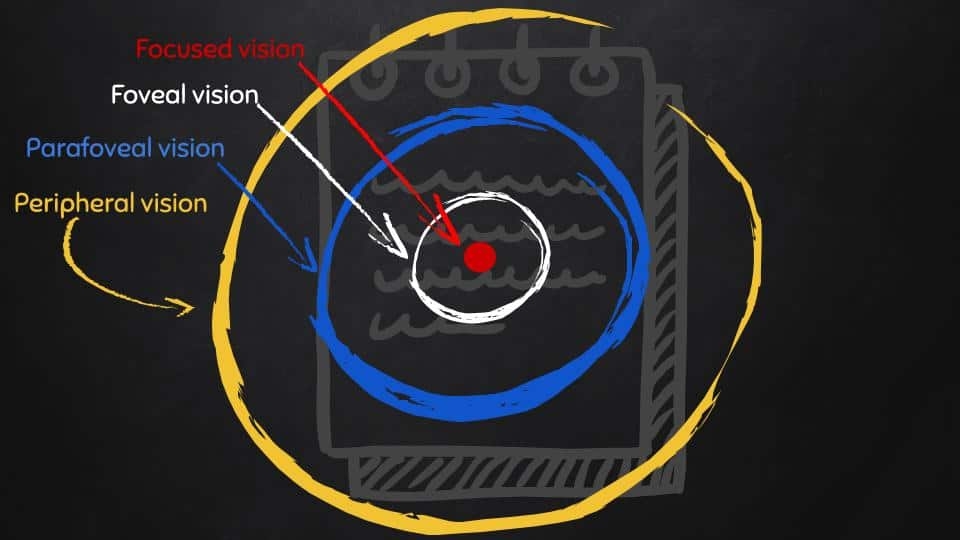
Our parafoveal vision can only detect ambiguous shapes and colours, but we can see more details as we move toward the middle of our vision (see figure above). There is a small area surrounding our focused vision called foveal vision, where our eyes catch anything that falls within this area in enough detail to understand it when reading. That is the most critical point in the speed reading process.
From now on, you have to change your old habit of reading in which you rely on your focused vision only to use your foveal vision in reading the text, like the diameter of the foveal vision when looking at a page in a book is about 4-5 cm.
You will notice how your reading speed will improve when foveal vision is used up to 70%.
2. Focus on what you read
You must focus if you want to master fast reading, as focus ensures you do not waste your valuable time going backwards without feeling.
2.1. Reverse
Going back is when your eyes go back to look at the words you just read. Although this action is not necessary, often as a result of poor concentration, or perhaps your mind is subconsciously trying to tell you that you need to take a second look at a word you may have missed.
To overcome this habit, you first need to be fully aware that you are doing so. Focus on this when you read, note when this happens to you, and then try to avoid it next time.
Reading with a percussion dancer is an effective exercise for learning to stay focused and avoid going backwards.
Every time the percussion dancer knocks, let them slowly go so you have time to read and comprehend the entire sentence. Then, when they hit again, move on to the following line.
Set your goal when reading to have a steady and even rhythm, as if you were playing a piece of music, and using a percussion dancer in this way will force you to know the meaning of the text as you progress and get rid of the habit of going backwards.
Speed up the rhythm as soon as you acclimate to its current speed, forcing you to read faster.
Many may find using a percussion dancer a bit odd, but it's a very effective way of teaching you to focus while reading.
Long-term persistence in this manner will teach you how to comprehend, allowing you to read words forward rather than backward. Your attention and memory will adjust to capture word meanings without reverting after you break the habit of doing so.
2.2. Regression in reading
The retreat is associated with going backwards but differs from it. Retreat is to voluntarily choose to go back and read a word, phrase, or paragraph again.
We usually retreat in reading for two reasons: either because we can't focus and get to the meaning of the text in the first place or because the text itself was challenging to understand.
You are not allowed to go back in reading the text, but there is nothing wrong with you retreating if your reasons are convincing; poor concentration should not make us fall victim to retreat, but it is okay to go back of your own volition to read the paragraph if the text is difficult to understand and to avoid unnecessary retreat; you should focus carefully on what you read to understand its content.
3. Reduce Page Width
Tim Ferriss's advice is one of the best and easiest to apply. Tim Ferriss is known for being an entrepreneur and author who has conducted many experiments on the human mind's ability.
He makes a great suggestion on taking advantage of foveal vision; he advises us to skip the first word when reading each line and start reading from the second word, then move on to the following line before our eyes reach the end of that line.
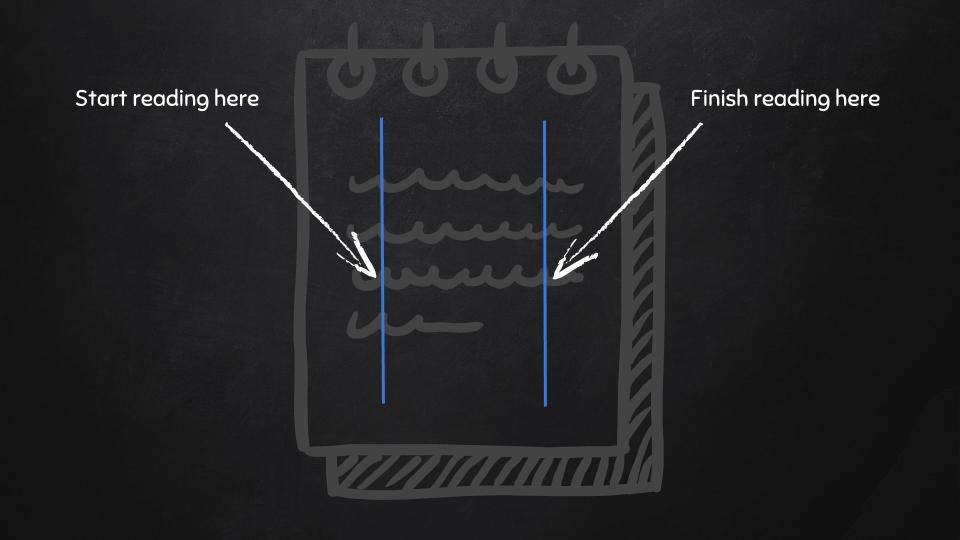
You can read more quickly by practicing because you won't make needless eye movements.
4. Using the Reading Guide
You need to know how to control the movement of your eyes to avoid going backwards and backsliding caused by a lack of focus. Your reading speed will suffer due to the untrained eye's sporadic glances at the page.
Use a pencil as a guide to help you control your eye movements. Use this guide to navigate the lines as you read from right to left, helping you keep your eyes on where you should be looking rather than getting lost on the page.
Integrate the pen guide technology with Tim Ferriss technology, and start reading lines line by line on the page. Moreover, using the reading guide also helps you reach an equal reading rhythm.
5. Increase Your Language Skills
Another thing that impacts your reading speed is your language skills and vocabulary, as language comprehension is the reason behind your ability to understand what you are reading, and often, our lack of understanding of words hinders our reading.
The introduction to a fascinating article in Psychological Science in the Public Interest illustrates what science is currently saying about reading speed:
“The way to maintain a high level of comprehension and finish the text quickly is by practising reading and becoming a more skilled user of the language (for example, by increasing the number of vocabulary). That is because language skill is the basis of reading speed,” and if you want to read faster, read often, regularly, and make an effort.
Conclusion
Mastering the speed-reading method needs the same effort as learning any other skill. The more you work, the better the results. However, the field of skill acquisition teaches us another additional lesson: You need training to improve and constantly increase your abilities as much as possible.



Add comment