Why is Failure Good for Success?
The most beautiful victory you achieve is the one in which you face many difficulties and challenges. The society around you does not reward defeat, and you will not find many failures documented in history books.
The only exceptions are failures that served as starting points for later successes. This is the case with Thomas Edison, the creator of the electric light bulb, the most famous invention in history. He claimed that it took him 1,000 tries to create a functioning prototype of it. He was once questioned by a journalist about how it felt to fail 1,000 times. "I didn't fail 1,000 times," Edison retorted, "the light bulb was an invention of 1,000 steps."
Unlike Edison, most of us avoid the possibility of failure, as we focus so much on not failing that we don't seek success, but rather live an ordinary life instead. However, when we make mistakes, we ignore them and amend those mistakes on our resume.
Jerry C. Bostick, responsible for NASA Flight Control, is reported to have stated during the mission to return the damaged Apollo 13 spacecraft to Earth: “Failure is not an option,” and that phrase has been etched in everyone's memory ever since.
In our success-based society, failure isn't just an unavailable option, but it is a deficiency, as confirmed by journalist Kathryn Schulz, author of Being Wrong: Adventures in the Margin of Error. As Schultz says: “Of all the things we get wrong, the most important is our view of wrong, because we are wrong about what it really means to be wrong. Wrong does not indicate intellectual inferiority at all. Rather, making mistakes is important to human knowledge.”
The Best Life Lessons Come from Failure
When we take a closer look at the great thinkers throughout history, the willingness to tolerate failure is hardly a new or unusual idea. From the likes of Augustine, Darwin, and Freud to the entrepreneurs and sports celebrities today, failure is as effective a tool as any for achieving great success.
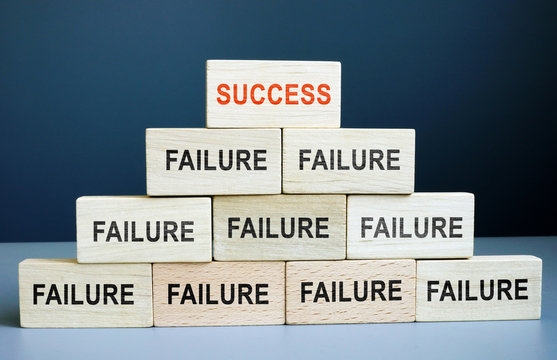
Ralph Heath, Managing Partner of Synergy Leadership Group and author of Celebrating Failure: The Power of Taking Risks, Making Mistakes and Thinking Big, says, “Employers choose not to take risks, not to draw attention, to repeat the same safe choices over and over, and they think that if they don't make any impact, then they won't draw attention and nobody will blame them for their failure because they are not trying to accomplish anything great that can fail or succeed.” However, in today's post-recession economy, some employers no longer shy away from failure, but they accept it.
According to a recent article in Bloomberg BusinessWeek, most companies seek out people who have a track record of success and failure, believing that people who have been through tough times have irreplaceable experience and perseverance.
Great success involves great risk, and failure is simply a common by-product. So the great leaders of great companies do not feel sorry for their mistakes, but instead, exploit them for future gains. “The fastest path to success is having an attitude of not being afraid of failure,” Heath says. “To do well, achieve success, and keep companies competitive, leaders and employees need to take risks a little every day.”
They also have to submit risky ideas, plans, presentations, tips, technologies, products, leadership, invoices, and much more, all without fear of failure, rejection, or punishment.
Reach Out Your Potential
The same applies to personal missions, whether in overcoming some specific challenges or reaching your full potential in all aspects of life. To achieve your best, reach unparalleled heights, and make all the impossible possible, you must not be afraid of failure, be ambitious, and work hard to achieve something.
When we think of people with this mindset, we imagine daring people, pioneers, inventors, and explorers. They embrace failure as a necessary step to achieving unprecedented success. However, that doesn't mean you have to walk a tightrope, climb Mount Everest, or cure polio to employ this mindset in your own life.

When the rewards of success are great, accepting potential failure is key to facing a variety of challenges, whether you are reinventing yourself by starting a new business or allowing yourself to trust another person to build a deep relationship.
“To achieve any noble goal, you must take risks,” says writer and speaker John C. Maxwell in his book Failing Forward: Turning Mistakes into Stepping Stones for Success, as he points to the legendary aviator Amelia Earhart, who set many records and firsts in her lifetime, including being the first female pilot to fly solo over the Atlantic Ocean.
Although her final flight was fateful, Maxwell believes she knew the risks, but the potential reward was worth it. Earhart's advice when it came to risk was simple and straightforward. "Decide whether or not the goal is worth the risks you're going to take," she says. "If so, stop worrying." This does not mean that you should try flying at night and then hope to get the best out of you, as achieving the goal requires effort, preparation, practice, and some awareness of your skills and talents.
Adopting Courage Mindset
"One of the biggest secrets to success is working within your strength zone, but outside your comfort zone," says Heath. Although you may fail miserably, you may succeed brilliantly, which is why it is important to take risks and feel brave. Either way, you will learn more than ever before about your strengths, talents, and determination, and strengthen your will to take on the next challenge. If this sounds like a risk, it might be, but there are ways to get used to the courage mindset, including the following:
1. Maintaining a Positive Attitude
A positive attitude must be consciously maintained so that no matter what you are facing, you can benefit from the experiences and keep moving forward. “Not everyone is naturally positive,” says Maxwell. He tells us that his father used to describe himself as a naturally negative person, but changed his attitude by choosing to be positive no matter the circumstances.
2. Reading and Listening to Motivational Material
Materials that reinforce your positive attitude should be read and listened to constantly. For example, Maxwell says: “My father read The Power of Positive Thinking many times, and I did not understand the reason for that, so I asked him why. ‘ Son, I need to keep getting information so I can stay positive,’ he answered’"
Reward your employees and praise their efforts in front of the entire organization, so everyone understands that it's OK to fail.
In Conclusion
Heath says, “If I am unmotivated and don't take a risk, someone will catch on, outperform me over time, and drive me out of my work. Therefore, you must keep looking for better ways to manage your life, or someone else will gain from and enhance your achievements, and they will be extremely satisfied with the outcomes. So, keep going or your career will be over.”