How to Integrate Children with Special Needs into Society?
One in ten children has a disability and is classified as having a particular need, as indicated by the most comprehensive statistical analysis conducted by UNICEF in November 2021.
Accordingly, the number of children with special needs worldwide is approximately 240 million.
The number written in the analysis is not shocking, and the large percentage of children with disabilities is not frightening. Instead, it is frightening those who are trying to marginalize this group, neutralize these children from the path of life, and exclude them in single prisons, forgetting the diversity and difference they add to society and the resulting richness and differentiation.
Therefore, the integration of children with special needs into society is a duty and inevitable that has many non-negotiable reasons. What we will discuss in this article is how to integrate them into society.
Who Are the Children with Special Needs?
Before getting into our topic about how to integrate children with special needs into society, we must first define precisely “Children with Special Needs”, who we can refer to as the children who are different from normal children in terms of physical, mental, sensory, linguistic, educational, or behavioral characteristics to the extent that the educator must provide exceptional services in education and support services, to meet the unique needs of the child.
Some people refer to this category of children as "disabled children." Still, most educators prefer the term "children with special needs" as it does not carry any negative connotations that would devalue them or label them as disabled.
Children with special needs are the group that has an essential difference from the average or typical children as they are referred to in English.
What Does It Mean to Integrate Children with Special Needs into Society?
The integration of children with special needs into society is a term that indicates the involvement of this group in daily community activities—enabling them to carry out the tasks and roles that their peers of normal children perform. The term integration also implies ensuring the existence of effective and influential community policies that allow individuals with special needs to demonstrate their presence and effectiveness.
The process of integrating individuals with special needs into society means activating their social role by participating in events and activities, easily using public services that include libraries, transportation, health care services, schools, and others, and establishing social relationships with those around them.
Integration includes all sectors in society, especially the educational sectors in which integration is by providing the opportunity for individuals with special needs to receive their school and preschool education in nursery and kindergarten alongside their peers from normal children, securing the requirements for this, to prepare the environment for them to integrate, and to break all barriers and obstacles that prevent their full integration with their colleagues.
The integration process is not limited to this sector only. Still, it goes beyond it to all sectors, as mentioned above, and we mean the medical, professional, social, and other sectors.
The integration of children with special needs into society is the equality of these children with disabilities with their normal peers, granting them all the rights that they receive and providing an environment that helps them to achieve these rights equally to all other children. Integration is the realization of the principles of justice and equality, and it is an ethical and social method. Its first and most crucial step is to inform others of the existence of this group and its rights to teach them the principles of accepting diversity and difference and emphasize the equality of individuals with each other and the absence of preference among them.
The Importance of Integrating Children with Special Needs into Society:
The importance of integrating children with special needs into society lies in achieving a social interaction between different groups of society and in getting all members accustomed to accepting differences and not looking at others with inferiority and derogation due to their differences.
The percentage of children with special needs in society is not insignificant. Therefore, marginalizing this group and underestimating its importance and the importance of its capabilities deprives society of employing all the potential capabilities of its members. It is known that a large percentage of children with special needs possess unique mental abilities or clear creative features. So integrating these people with the rest of society is a notice to them of equality, which is an incentive to release their creativity and superiority towards the light and to benefit from it in the progress and development of society.
From a financial point of view, integrating children with special needs into society saves high costs, which should be spent on establishing centers for their rehabilitation and education. So participating in public services with normal children saves money and gives a better result in their education and their establishment of social relations, depending on children's instinct to be social creatures and quick to learn, especially from each other.
It is worth noting that the integration process contributes to strengthening the motives for the love of learning and competition between children with special needs and their peers and raising their motivation to establish social bonds. This enhances their psychological health, increases their sense of self-esteem, and increases their entitlement.
How to Integrate Children with Special Needs Into Society?
The step of integrating children with special needs into society is arduous and not easy at all in some societies that consider this category to be punished by divine punishment that dictates their contempt and belittling. Still, conscious societies are the ones that accept human beings of different physical and psychological characteristics and see that diversity increases their wealth and richness. They look positively at every color of individuals and combine them in a societal rainbow that includes all shades.
On how to integrate children with special needs, we answer:
Family First
The family is the biggest factor in making a child with special needs able to integrate into society because the integration process is the outcome of a child with special needs readiness for that and preparing the community of the surrounding environment to complete this process. Therefore, the role of the family is to explore the child's strengths and the points that must be worked on to complete the process of their identification with society.
For example, for children with communication problems, their families must encourage them to create social connections and engage with others.
Perhaps the first step in this is for family members to accept the presence of a child with special needs among them and not to treat them as a burden that weighs them down or as a load that they must bear forever, rather, they must accept their difference, and not look at what they cannot do, but rather look at what they can do, and rely on them to implement it.
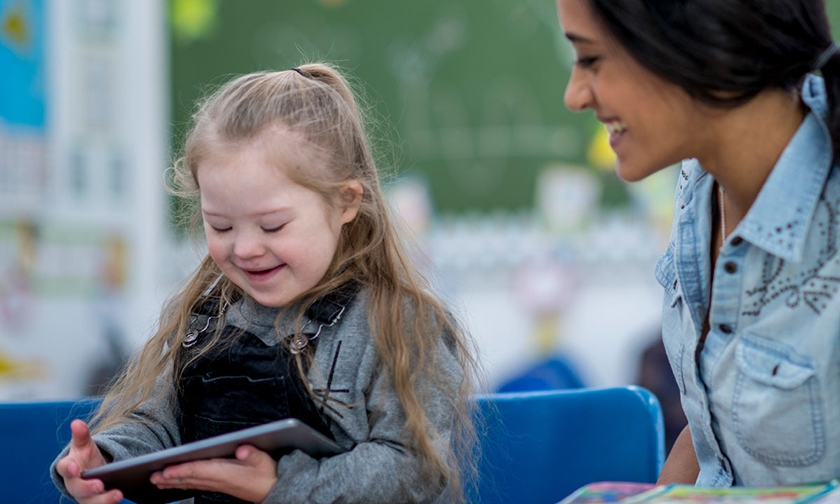
For example, when a child with Down syndrome is born, the family must involve them in all activities in which they can participate. Children with this syndrome at a certain age can move dishes to and from the table and are also able to do some homework.
The child’s practice of these tasks that are appropriate for their age and abilities enhances their self-confidence, and the family increases this confidence by treating its child with respect, praising their good behavior, and always encouraging them so that they grow up appreciating their self-worth, and not bearing any feelings of inferiority from their peers.
It is among the duties of local organizations to provide rehabilitation centers for the families of these children, to teach them the principles of correct dealing with them, and to guide them to the best methods of communicating with each other and with the environment that looks at them with pity or astonishment, based on the importance of the family’s role in laying the first building block for the process of integrating children with special needs with their communities.
Concerned Authorities Second
In the process of integrating children with special needs with society, it is the responsibility of those concerned authorities from government institutions or owners of important establishments to take into account the presence of individuals with special needs who may visit their facilities. Hence, they provide a safe environment for their presence, such as wide walkways, alternative ramps for wheelchairs, and other facilities that make it not confusing for children with special needs to leave the house.
Also, raising awareness among children about the existence of a different group through television programs or magazines directed at them is in the interest of integrating children with special needs into society.
Community Third
We may often encounter in the play center a mother with her child with special needs, and although the place may be prepared to receive these cases, the mother does not seem to be comfortable. The reason for this is the lack of knowledge of the human cadre in the place and its patrons on how to deal with children with special needs, and here emerges the role of awareness and self-education related to how to deal with this group, or at least accept its existence without looking at it with surprise or dealing with pity with them and their families.
In these cases, the parents of the child also have an effective role in taking the initiative and informing people of how to properly deal with children instead of withdrawing from them or going to those responsible for the place and asking for facilities for this category of children if they are not available.
In Conclusion
Children with special needs are not a small proportion of society, and they are neither a burden nor a heavy load on it. They are natural individuals like others who have human rights imposed like other individuals without favors, and their integration into society advances it for the better, as it succeeded in investing their qualifications and talents and employing them in serving the values of truth, goodness, and beauty.