The Importance of Planning: How to Create a Plan for the Next Five Years?
What is your life plan? Or do you have a life plan at all? Or what do you seek in your life?
These questions are among the most common questions that you face while applying for a job in oral interviews. Some people give a short answer by saying I want to become such or such without mentioning how, and others cannot provide a clear answer because there is no plan or because of their ignorance of how to plan for life. If you are one of these people, this article is your gateway to knowing the meaning of life planning and how you can create a plan for the next five years.
What is life planning?
Personal planning is a process that aims to show how the individual moves from the current situation to the desired situation, as it is the way to achieve the desired goal. Think of it as a map that shows the path that will lead you to achieving your dreams and facing all the possible challenges that may arise during this and how to do so.
Every person wants to reach a place through which they can fulfill their ambition and prove their personality and self, but this can only be done by setting specific, realistic, and achievable goals, as well as the appropriate steps to achieve each of them, so that they finally reach the main goal of the future that they promised themselves. Each individual is the creator of their own life.

What is the point of life planning?
Many people have questions, such as, “Why should I plan for the future? What is the benefit of that plan? What is the difference between a written plan and a plan in my mind?” The answer to these questions lies in the following benefits:
- A written plan is better than an oral plan. Life is busy and fast-paced. If the individual drowns in its vortex and strays from the path they have drawn for themselves, they can, through their written plan, return quickly to correct and complete what they planned. Even adjusting it according to the sudden requirements of life gives you order.
- Reading your plan will motivate you to achieve it.
- Achievement increases; rather, it doubles sometimes when writing the goal.
- You will be able to analyze each goal and determine what is needed to achieve it (the implementation mechanism) more accurately, in addition to the ability to overcome the obstacles that you may encounter during good preparation.
- Organizing time, as time is the decisive factor in a person's life and must be used optimally.
- Achieving a balance between different aspects of life.
- Reducing the feeling of fatigue: the individual's knowledge of daily duties makes it easier for them to perform them and organize rest times during them.
- Performance evaluation: The idea of having a written plan gives you the ability to evaluate your performance and the extent to which you have achieved the set goals.

Steps that will help you develop a plan for the next five years of your life
1. know yourself
The first step in creating a life plan is to know yourself well, and to do that, you can follow one of the following methods:
1.1. SWOT Analysis
|
SWOT |
|
|
Strengths |
Weaknesses |
|
Opportunities |
Threats |
The SWOT analysis consists of four main areas: Strengths, Weaknesses, Opportunities, and Threats. It is a great tool for analyzing and evaluating yourself in order to know what you have and what you need, what opportunities are available to you, and what threatens to turn those opportunities into successes.
Strengths
Strengths are among the positive qualities in your personality, in addition to the skills and advantages you possess over others, as well as the healthy habits that you possess.
Examples of questions that can help you:
- What educational qualifications do you have?
- What skills do you possess?
- What skills do you possess that distinguish you from others?
- Do you have experience in a field?
- What business have you practiced and been successful in?
- What good qualities do you possess?
- Do you have social knowledge that can open up new practical horizons for you?
- How do you find your ability to influence others?
- Are you flexible and adaptable?
- What emotional intelligence skills do you have?
Weaknesses
In turn, it indicates the negative characteristics of your personality and the bad habits that you have, in addition to the lack of skills that make you a loser in competition with others. Here are also some questions that will help you do that:
- Can you control your emotions?
- Do you suffer from shyness, introversion, isolation, depression, anxiety, and stress?
- Do you fail to solve the problems that confront you and cannot change in reality?
- Would you mind working with a team?
- Do you suffer from maladjustment?
- Do you have a civic level of self-esteem?
- Don't you have any preferences that distinguish you from others?
- Do you have bad habits? Which are not adjustable?
- What do others think of you?
Opportunities
Do you have any potential for new experiences that enhance your character's strengths and skills? Are there any new areas that might match your abilities and experience? Has a job been announced that meets your ambition, and so on?
- Is there a new and good job opportunity available? Or are there any new developments in your business that will benefit you?
- Has the method of executing your work changed in a way that makes it easier? Like moving from working on papers to using a computer.
- Will learning a specific skill give you an advantage in your field of work?
- Are there training courses available for you to enroll in?
All questions that end in a chance can be added to this group.

Threats
What are the obstacles to achieving your goals and preventing your success? Are there certain qualities in your personality that are difficult to get rid of and stand as a barrier between you and success? Among the questions that will help you analyze:
- Is there another person in your workplace who is more qualified than you and who can influence your work?
- What is something that other people have that you don't and that could be dangerous to your business?
- What obstacles do you face in your life that prevent your progress?
You can also use, in addition to the SWOT analysis template, many other methods, such as:
1.2. Brainstorming method
It is based on describing your life in detail, defining your dreams and hopes, the things you want to achieve, the means available to you to achieve them, as well as what prevents them from being successfully accomplished, and how you will rectify those obstacles and problems, in addition to identifying your pros and cons.
1.3. Life Balance Wheel
It is usually known as the wheel of life balance, and in principle, it is based on identifying eight important aspects of your life and knowing the extent of balance between them through your satisfaction with them. You must follow the following steps in preparing it:
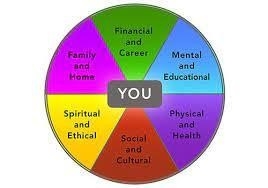
- Identify eight areas that you consider essential in your life, paying attention to the presence of things that should not be overlooked, such as religion, money, health, work, hobbies, family, emotional state, and social relationships, and draw them within a circle as follows:
- Determine the degree of your satisfaction with each of them, and you must be frank with yourself and remember that this wheel is yours and no one can see it or embarrass you through it.
- After completing your idea of yourself, you can now start defining your goals in each of these eight areas and where you want to reach in each of them, but beware of exaggerating in setting goals; you must choose achievable goals first and be able to stick to them as well.
2. determine the values upon which your life is based, and what are your motives?
Determine the ethical system that governs your actions and behavior and the values that you adhere to and that have become an essential part of your personality and give you satisfaction and acceptance, such as honesty, sincerity, dedication to work, helping others, justice, respect, and others.
3. write down your goals accurately and in their three types
- Short-term goals: These are the goals that are characterized by the short time required to achieve them.
- Medium-term goals: These are the goals that take between one and three years.
- Long-term goals: These are the goals that take five years or more to be accomplished, and you must write down the duties and tasks that are supposed to be done to accomplish each goal.

4. assess your ability to achieve the goals
Giving an assessment of your ability to accomplish each of the previous goals that you set according to specific criteria, such as time, the capabilities available to you that you can benefit from, and the suitability of your personal abilities with the goals set.
5. identify the activities
Determine the activities that you must do in your quest to achieve what you want, and attach each goal that you have written to the appropriate activities for it.
6. create your weekly schedule
This will help you identify wasted time and make up for it. Determine the special tasks and duties that must be done for each day of the week and the time allotted for them, whatever is needed to achieve them.
7. protect your goals
Work to protect your goals and not allow anyone to change them or stand in the way of achieving them.
Conclusion
Everyone wants to have an ideal life characterized by success and distinction, but nothing comes for free. Hence, everyone must make an effort to strive to achieve that life in all its details. So make and stick to a life plan that will help you achieve the life you want.