Two Major Pillars for Time Management
Do you ever feel like there isn't enough time? Consider setting three tasks for the day, starting the day with a lot of enthusiasm to complete them, but ending the day with only the first task barely completed due to other demands on your time.
Note: This article is based on the work of author Celestine Chua, in which she tells us about two basic pillars that we must follow in order to control our time.
The first thing you should understand about time management is that you have the same amount of time as everyone else in the world. Successful businessmen and entrepreneurs like Steve Jobs, Bill Gates, Warren Buffett, Tiger Woods, and Michael Jordan all have the same amount of time, which is 24 hours per day, 365 days per year.
Due to the fact that time is always present and constantly unfolding in front of you, it is unmanageable. You cannot organize "your time," change the length of the clock, or make time move more quickly or slowly.
Humans invented the concept of time
The idea of time was created by humans. It is a measurement system created by man to give purpose to what we do. Humans only invented words like centuries, decades, years, months, weeks, days, hours, minutes, seconds, and milliseconds to claim control over the passage of time.
However, the human creation of this idea was appropriate because it allowed us to create harmony and understanding among all people so that we could live orderly lives. Your friends understand you when you say, "Let's meet at 9 o'clock on Friday."
This is because we all share a common understanding of how time works, as defined by weeks, days, hours, minutes, and seconds. In reality, time is just time; you don't need more time, and you don't run out of time; time is always there.
Reframe the time management issue as follows
You already have the tasks that must be finished by the end of each day; what you need are better skills and techniques to manage those tasks and make sure they are finished within the allotted time. Task management and self-management, not time management, are the skills you need to learn.
The author of Getting Things Done, David Allen, once said, "You can't manage time; that's not the real problem, and it's not an effective approach; what you really manage is your activity during that time, and setting results and required action is the basic process required to manage what you do."
The subject of task management is so vast that it cannot be covered in a single article, but I will go over its fundamentals as well as frameworks and techniques for self-management that you can use in your daily life.
Since "time management" is such a widely used term, I will use it interchangeably with the term "task management" in this article. However, keep in mind that what I really mean is that "time management" is a misnomer and that what we really care about is looking for task management and self-management.

The Fundamental Pillars of Time Management: Effectiveness and Efficiency
Effectiveness and efficiency are the two key components that make up time management.
1. Effectiveness means doing what’s important
It entails setting priorities, concentrating on what is necessary to get things done, and crossing out things that don't fit with your bigger life objectives.
2. Efficiency means achieving maximum results with minimum time and resources
This entails having the ability to work quickly and precisely while using the same amount of time and resources to achieve better results. The first step in time management is to prioritize and complete your tasks in that order, followed by increasing your productivity on those tasks, as I'll explain below:
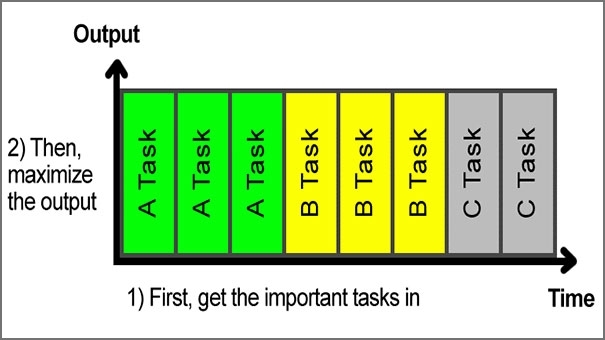
The tasks (A, B, and C) are ranked according to importance, with task A being the most important, followed by task B, etc. Therefore, you must focus first on the most crucial tasks (effectiveness), then improve the outcomes of each task (efficiency).
The first pillar: Effectiveness
When it comes to time management, most people blame their own inefficiency when the real solution is to become more efficient. Efficiency can be used in two different ways: first, by prioritizing the important tasks over the less important ones, and second, by concentrating on the key elements of the key tasks. Establishing priorities is the cornerstone of effectiveness.
Step 1: Get the important tasks done first
You can be more efficient if you give your tasks a priority. If you frequently find yourself lacking the time to complete a task (such as exercising or paying attention to your relationships), it is likely because you did not give it enough priority and instead chose to complete other tasks.
You might not understand how important this particular task is in comparison to the other things you have going on, or you might be stuck doing things that are pointless.
For example, you might have planned to work out after work, but the demands of work are keeping you from doing so. In this example, you gave work precedence over exercise. Maybe you quickly weighed the advantages and disadvantages of work versus exercise and decided that work was the best choice. The work was urgent and needed your immediate attention; the exercise could wait until another time.
Whatever it may be, you have chosen to act as you have, and how far you advance in time management depends on your choices. Some people occupy their days with sporadic activities like TV watching, online chatting, and web surfing. They consider their day after it is over and consider their location. Was their power lost when they disappeared? No, but they chose to prioritize these unrelated tasks over what was actually important to them.
This prompts the question, "What is really important to me? And are the tasks I'm working on now really the most crucial ones I can complete in my life?
Step 2: Pay close attention to each task's crucial components
Imagine that you have a presentation to prepare and that you give it higher priority than the other items on your to-do list. However, as you work on the presentation, you spend the majority of your time on less significant side tasks, and rather than focusing on the caliber of the content you will deliver, you spend 50% of your time changing small details like the font colors and text alignment on each slide.

I'm not arguing that presentational style and professionalism aren't significant. However, you must be clear about the objective and give this task top priority. If the goal of this presentation is to earn an excellent grade, for example, that grade will be determined by the content you present, the style you use, and the audience's engagement with you, so the slide design may not have a significant impact on the audience's opinion.
Given this, content and delivery—rather than design—are the main components of this presentation task. There is a difference between devoting 10% of your time to design and 80% of your time. These minor details won't have a significant impact in the long run unless your slide design is genuinely awful. I spend more time organizing the idea, the presentation, and potential questions as I give more presentations than I do on smaller details like layout and appearance.
When I first started giving presentations at university, I remember wasting a lot of time on design and coordination that didn't really matter in the end. I was also delaying work on the content of the presentation and putting it at the bottom of my to-do list, and this was a huge mistake because, as time was running out, I needed to work on my speech and how to deliver it, both of which were crucial things.
Depending on the audience I'm speaking to, my presentations these days can be as simple as black text on white. Of course, if the audience values design as a component of content, I'll put more effort into the design because, after all, prioritizing important steps is what presentations are all about.
The second pillar: Efficiency
Efficiency is about doing things quickly and accurately, and it has less of an effect than improving efficiency because there is a limit to how fast and how much we can do within our human capacity.
Consider that you have a 6,000-word report that you need to write. You have already written it on paper, and you need to type it at a speed of 60 words per minute (WPM) on a computer. In this example, you can complete the task in 100 minutes. If you try to write faster, that is, 65 words per minute, you'll finish the task in 92 minutes, saving 8 minutes from your original timing, which is fine but not particularly significant, provided you don't make many typing mistakes.
On the other hand, increasing your efficiency can be beneficial to you; doing the right things first will help you save time. Writing the report directly on your computer, as opposed to writing it on paper and then transferring it to the computer, which adds another step, is an example of efficiency.
However, using a scanner to enter text into a computer can result in errors, so it may not be a good solution like the previous one. You can also delegate or outsource data entry, which results in getting the job done without wasting your time. When you are in a higher position and have limited time, it is helpful to delegate your tasks for a certain fee because the time you earn is much more valuable than the cost of hiring someone.
Improving efficiency is certainly important, but before we work on efficiency, we must make sure we are effective, which usually involves changes in the way we think about our tasks and changes in our approach, while efficiency means increased speed, work, and accuracy.
In conclusion
Most people today make the mistake of working on efficiency, thinking that this is all about time management, but effectiveness must come before efficiency to increase our productivity. When you improve both effectiveness and efficiency, you make the most of your life.