Changing a Child's School: Difficulties and Solutions
School has a significant role in shaping a person's identity and preparing them for social acceptance and data adaptation.
As the foundation for receiving cognitive and technological advancements that have altered social life's characteristics and accelerated social change, schools must now keep up with these developments to ensure that their students are positively adapting to the demands of the modern world.
This school-led transformation is not a haphazard process—changing for the sake of changing—or a personal matter for decision-makers; rather, it is a civilized issue tied to society, its aims, and aspirations, working to overcome the drawbacks in order to guide students to a better future.
The child spends many hours each day at school interacting with teachers, making friends with classmates, and beginning to develop their knowledge and skills. It is said that the school serves as their second home.
We find that the child frequently clings to school, loves being there, and doesn't feel out of place there. They will occasionally even cry if their parents must stop them from going to school for some reason.
A bigger issue, though, is when parents find themselves having to move their child to a different school. The youngster is terrified of the unfamiliar and weird environment; they don't know their classmates, and there aren't any teachers they adore who are familiar with their needs.
Since the school has to compel the new child to adjust to its surroundings, comply with its laws, and strive toward its goals, this stage presents enormous problems for the child, the family, and the school.
It is a very tough procedure that takes planning, breaking it down into steps, and carrying it out across numerous stages, as well as the collaboration of all the participants, in order to ensure its success. It is neither simple nor random.
What are the reasons that drive parents to transfer their children to a new school?
1. Relocation or parent separation
Relocation is one of the most common reasons for parents to change their child's school. The residence is changed either due to moving to a new house, one of the parents obtaining a job and having to change the place, or the separation of the parents and the child having to move to live with one of them.
2. Financial reasons
Perhaps the child is in a school that is financially expensive, and the parents are no longer able to pay their tuition, so they work to transfer their child to a new school that is commensurate with their capabilities.
3. Reasons related to the child himself
Such as not adapting to the school environment and suffering from psychological problems such as shyness and introversion, aggressive behavior towards teachers and colleagues, exposure to school violence or bullying, and so on.
4. The child's low level of educational achievement
The child may not receive the proper care at school, be able to adapt to the teaching style, or even accept changing the teacher they are used to. Since this is a significant factor affecting the student's achievement, parents may want to move their child from one school to another in order to address this issue.

What factors should be taken into account when deciding whether to transfer the child from one school to another?
1. The child’s feelings
When a child transfers schools, they may have psychological issues, such as separation anxiety from their teachers and friends, which has a detrimental impact on their mental health.
Therefore, before taking this action, you must speak with the child, learn about their concerns about leaving school, and persuade them of the significance of switching schools in order to improve themselves, as well as the new experiences and things they will love at their new school. The child must be informed of the security and comfort they will experience at the new school.
2. The child’s social relations
During their time at school, the child spends many hours with their friends; they play with them, do school activities with them, and feel comfortable and safe being with people they are used to. The same applies to the teacher. Some, if not all, children see the teacher as a role model and, at times, have an excessive amount of love for them.
In any case, the child's loss of their closest friends or the teacher they adore will be a severe issue for them and have an impact on their mental health. As a result, caution must be taken when transferring a child out of school and making things as simple as possible for them.
This can be accomplished by making sure they routinely visit their friends, stay in touch with their cherished teacher, and make friends with new people they get along with. This procedure is carried out gradually and step-by-step.
3. The quality of education in the new school
The new school must conduct a needs analysis and determine the type of educational curricula it offers, the teaching strategies it uses, and the teaching personnel. What are its prerequisites? Do they use productive channels of communication with the student's parents? All of that is coupled with the kinds of extracurricular activities the school chooses to support children’s talents and so on.
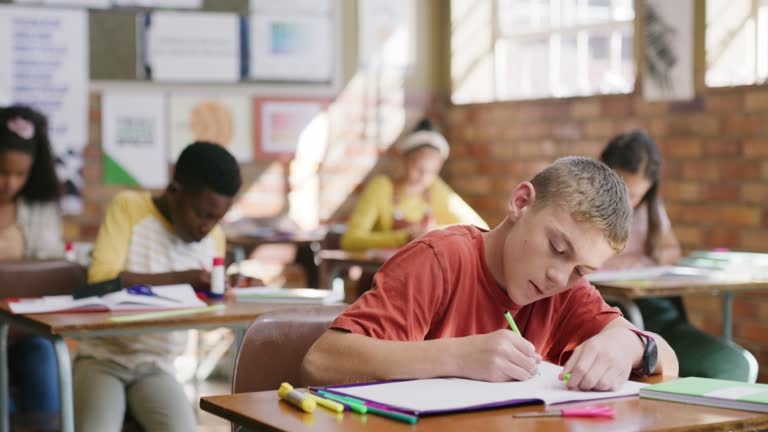
Difficulties in changing the child's school
- A child's worry and anxiety upon entering a new school when he is utterly oblivious to what is there: They are worried about new teachers and classmates, how they will get to know them and get close to them, and so on.
- Introversion: A child may become withdrawn as a result of changing schools, avoiding participating in school activities or even playing with classmates, and tending to isolate and remain alone.
- The child's academic performance is below where it was: The child may be one of the top performers in their class, but changing the school may cause the child's educational attainment to decline due to their inability to adapt to classmates, teachers, or the method of learning.
- The child is vulnerable to bullying at school.

How can the issues that arise from the child's school change be resolved?
When a child moves to another school, there are a number of issues that can be resolved by taking certain actions. As the child's second home, the school must make them feel at ease, secure, and at ease. The following actions could be taken:
- Parents should drive their children to their prospective new school a few times when considering transferring them there: To know the location and distance separating it from home and what advantages it might provide for the child.
- The new student should be formally welcomed by the faculty, staff, and students of the school: By welcoming them on the school radio, the class teacher asks their students to introduce themselves to the new child, and the teacher can welcome them more than once during several days to make them feel comfortable.
- Always talk to the child: Not allowing them to be isolated and away from their classmates.
- Ask the child's classmates to involve them in playing: With the aim of helping the child make friends, parents can ask the teacher about the child closest to their own when playing. This can push their son to make more contact with them outside of school as well.
- The teacher should help the child know the topics discussed in class: The child must also be given a summary of each subject and what has been accomplished in it until their arrival, so that they can keep up with the educational process and achieve the required integration.
- Involve the child in classroom activities: Encourage the child to take part in classroom activities.
- Both the psychological counselor and the social counselor in the school should talk to the child: On a daily basis, during the first period of their arrival, social and psychological counselors should talk to the child and listen to them to help them adapt to the new atmosphere.
- Parents should visit school: Parents should constantly ask about their child’s status at school, their behavior, and the challenges they face in order to overcome them little by little.
- Parents should listen to the child’s daily life at school: They could ask about the things the child did and the things they want to get. They can also ask the child to tell them about their new experience and the things they liked. Through these conversations, parents can know the problems facing their child and the fears they have and work to solve them.
- Parents should accompany their child to and from school: This is only during the first period, as it gives them a sense of security.
- Provide a good environment for the child at home: By creating a special schedule that includes the hours spent awake, asleep, studying, and eating.
- The family should take the child to visit their old friends during the holidays.
- The family must constantly monitor the child: Upon noticing any strange behavior, such as their tendency to isolation, increased shyness, or other intense emotions such as anger and aggressive behavior, patients should consult a specialist psychiatrist to solve the problem before it escalates.
In conclusion
It's not always easy to transfer a child to a new school and move. The child may be vulnerable to feeling alienated in their new school, experiencing dread and anxiety, becoming quiet or introverted, and experiencing a wide range of other behavioral and emotional changes.
These changes can lead to mental health problems and complexes that have an impact on the child's future and social and mental stability.
In order to protect the child's safety and mental health as well as aid in their adjustment to the new school, the child should be informed in advance about the transfer procedure.