How Do You Use the Time Management Matrix to Accomplish Important Tasks?
Time management is the first thing we lose control over when significant life events or disruptions happen. In those circumstances, time might stop having any meaning, and it becomes evident why the terms "urgent" and "important" take on new meanings.
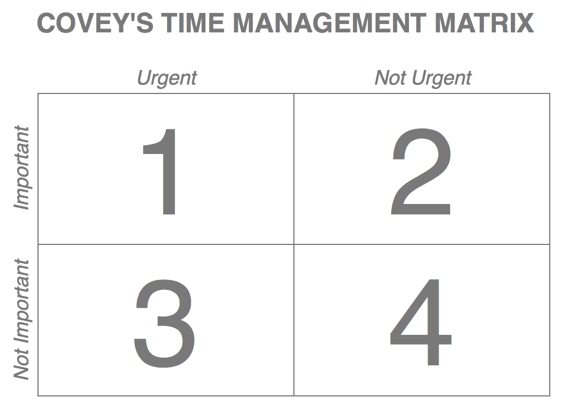
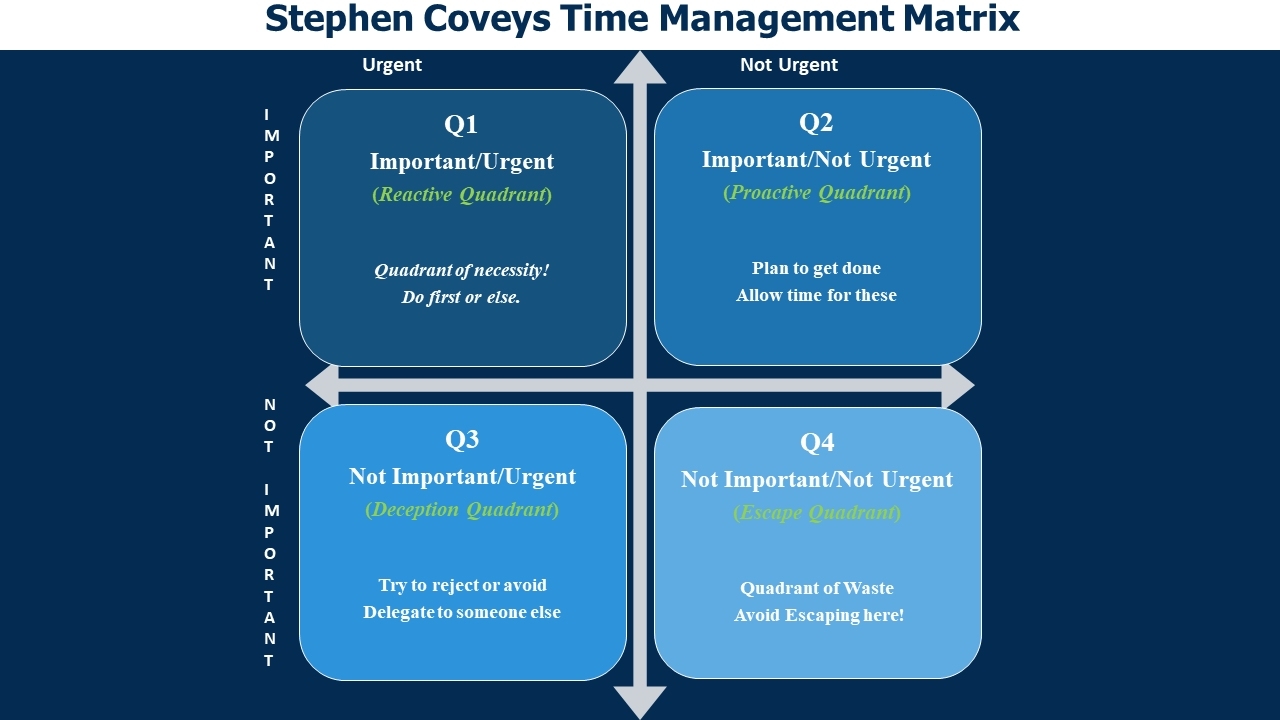
In his book “The 7 Habits of Highly Effective People,” Steven Covey introduced the Time Management Matrix, a concept that breaks down the time we spend waking up into four parts:
- Part 1: Urgent and important, such as getting help in a medical emergency or preventing a young child from hitting a car.
- Part 2: Some things are important but not urgent like regularly changing your car's oil or helping the business reach its objective of answering all customer calls within an hour.
- Part 3: Important but not urgent tasks, like responding to an offer that expires soon or answering a colleague's question.
- Part 4: It is neither urgent nor important, like browsing social media, responding to comments posted by people you do not know, or watching TV for long hours.
How Do You Use the Time Management Matrix?
To maximise the utility of these four sections, we must be extremely transparent about how we handle Covey's terms. Here's how to do that:
1. Tying time to money
If you want to eliminate the time-wasting factors in your life, start treating your time as if it were money. Tieing time to money will quickly clarify the concept of time being a great asset, which may otherwise seem nebulous.
Dave Ramsey, a financial expert, advises keeping track of every penny you make by classifying your earnings. For instance, $1,000 of your upcoming paycheck might go toward rent, $400 toward groceries, and so forth.
Time management will become a task of guesswork and gut feeling without splitting and monitoring time into categories. Integrating COFE technology with the time management matrix is the first step to managing your time. It has been determined that thirty dollars is the equivalent of one hour of your time. For example, you could spend $135 watching TV for 4.5 hours. Put this in your daily log under the category of "Entertainment." And if you're like most people, you may understand the issue clearly at the end of the month when you add up the total amounts you set for your different life categories.
You may underestimate the $135 you spent watching TV in one day, but how does it feel to find out you spent $1,485 in one month in that category? Remember that your time per month (31 days) - assuming you stay awake 16 hours a day - is worth $14,880, so you may consume hours alone between $4,500 and $6,000.
Now, you can know how to manage your priorities very clearly. Was watching TV really worth about 10% of your total waking hours? Only you can answer this question.
2. Prepare yourself for success in the Time Management Matrix
2.1. Start writing down all the tasks
Right now, all you're attempting to do is write down your ideas and don't waste time worrying about what has to be done by a specific date or what is urgent. That section will be added later. Just try your hardest to list what you're considering doing in a spreadsheet or on paper in the interim.
Jot down your thoughts using the best tools that suit your needs as soon as possible. Don't stop until you ensure to write down everything you remember.
2.2. Set a deadline for each task
It's essential to prioritise meeting deadlines that you know won't change. Building strong relationships with others involves making their commitments a priority. To avoid rushing, set your deadlines as far in advance as possible, giving you extra time if needed. By implementing good time management habits, you can become someone who consistently exceeds expectations and never makes empty promises.
Concentrate on urgent tasks, but exercise caution in defining what is urgent. What is urgent for you might not be for your friends, family, or clients. Although each person must establish their own unique definition for use in the workplace, this classification should typically be applied with caution.
Arrange previous obligations based on your rating; you can always go back and improve a task to this level, but you must first exercise restraint. After all, if you see everything urgent, nothing is really urgent.
2.3. Reorder your list by importance
Here, it's crucial to use a spreadsheet rather than paper. Complete the spreadsheet's importance column, or use a different coloured marker if you're using paper or index cards. Next, rate the importance of each task from 1 (not critical at all) to 100 (for maximum importance).
Because of its accuracy, a scale from 1 to 100 is preferred. When sorting, you can distinguish between tasks that score an eight on the scale and those that score an 82 or an 88.
3. Include your life in the time management matrix
Now, take a step back and assess your situation. If you have completed your homework, you should be able to see each task listed, along with its priority and urgency.
Place each task in one of the four sections of the time management matrix to begin. It is best to start with clear topics. You can assess comparable missions that can be divided into two sections once they are on the chart. It's acceptable to rearrange the order in which you prioritise or urgently complete tasks. Some might not be as urgent or significant as you first believed.
3.1. Part 1 “Keeping this part open to all possibilities"
Keep as many tasks out of the urgent and important parts as possible. That may not be possible on your first try at time management, but in the long term, try to keep the first part open. You can do this by handling the new tasks in the other three parts as effectively and efficiently as possible.
For example, a startup founder wants to stay fit but lacks time to spend in the gym.
Wall Street Journal writer Dr. John Jaquish says, "Variable resistance exercises are scientifically proven to lead to better fitness results in much less time, along with a high-protein diet that can give entrepreneurs the results they want without sacrificing valuable time of day."
A customer might call and ask for something in ten minutes you believe belongs in the first section. You possibly haven't planned or prepared anything to stop it from ending up there, so it's not your fault; your responsibility is to keep this space open to this possibility.
3.2. Part II "Completion of Time-bound Tasks"
When something is important, it's likely, at some point, to become urgent. For instance, you should change your car's oil before it breaks down; if not, the engine should be abruptly moved from the second to the first part, requiring you to buy a brand-new first part or rent a car.
Even though some Part II assignments might not be urgent, that doesn't lessen their significance. According to Forbes author and contributor Dana Brownlee, "You may be committed to learning more to help promote anti-racism in the workplace, but that goal will likely only be achieved if you schedule time in advance in your daily program to ensure that you devote the time needed to achieve it." It will never be possible to complete these assignments without conscious effort to schedule them.
3.3. Part 3 “Asking Some Questions about Urgent Items”
One issue in this category is that urgent tasks frequently appear important, and it is usual to confuse the two. As such, learning to distinguish between the two is essential. It's urgent to respond to a text message from a prospective client, but you can wait until Friday to respond to an email from the insurance company asking for a meeting to go over the annual policy.
While voicemails, texts, emails, and other instant messaging are constantly urgent, they might not be crucial. Consider if you feel the same sense of urgency as the sender when you look at the tasks in Part Three. It's time to de-clutter Part Three by unsubscribing from specific individuals, groups, or newsletters.
3.4. Part 4 “Making the most of your non-urgent and insignificant activities”
Everyone who wants to become an expert in time management wants to skip over the fourth section, but take your time. Although cutting wasted time is undoubtedly your goal, this section also includes breaks. Make the most of the activities you are in, rather than promising to cancel all of the fourth part's activities.
Initially, begin rescheduling or assigning assignments that don't make the most use of your time. Yes, you might need to reformat a report, but it would be better to delegate this task to a trainee and use software to automate the sending of critical emails so that you won't have to send them all by hand.
Make the most of Part IV by choosing your leisure activities wisely. When it comes to resting, know what activities make you feel rested and what makes you feel exhausted. Agree to go for a walk in the woods. Refrain from arguing with strangers on social media.
Final thoughts
When you feel like your program is controlling you rather than you controlling it, the COFE Time Management Matrix is a great tool to use. It also depends on how honest you are when you categorize tasks.
It is very easy to accept someone else's classification of something as "important" or "urgent" without challenging them. However, you should never be afraid to ask yourself, "Is this really urgent?" You accurately distinguish between what is important to you and to someone else.
The benefit of time management is that it removes the need for inflexible thinking and provides you control over your schedule. Particularly entrepreneurs should consider including flexibility in their programs to seize any opportunities. On the other hand, excessive flexibility will result in time wastage.
You will eventually succeed as you adapt the COFE and Ramsey techniques to your circumstances, allow yourself to make errors, and make necessary adjustments.